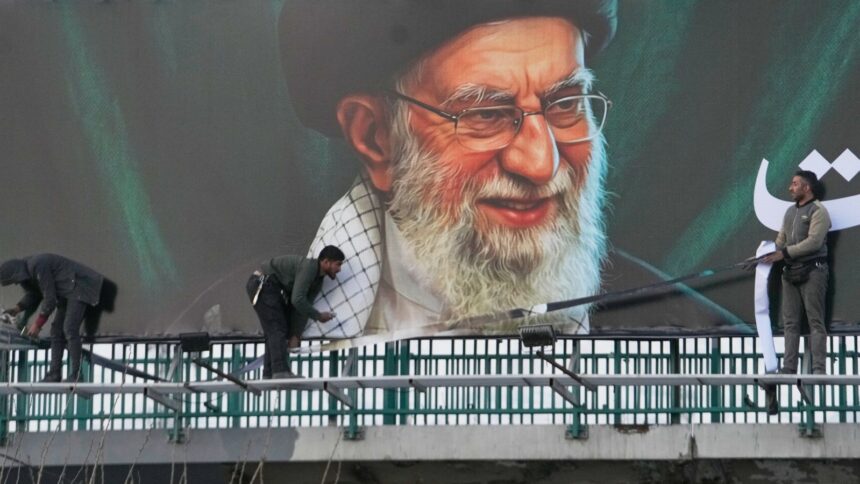
The assassination of Iran’s Supreme Leader Ayatollah Ali Khamenei in an Israeli air strike last week was the result of a prolonged intelligence operation by Israel, which involved hacking into nearly all traffic cameras in Tehran, disrupting the functioning of mobile phone towers and compiling detailed dossiers on the “highly trained” and “loyal” bodyguards and drivers of senior Iranian officials, a Financial Times report revealed.
The report, which gives out extensive details on the planning that went into the killing of Khameini, also said that during the June war and now, Israeli pilots used a specific kind of missile called the Sparrow, variants of which can hit a dining table from more than 1,000 km away.
Israeli intelligence was privy to when the bodyguards and drivers of senior Iranian officials came to work near Pasteur Street in Tehran on Saturday, the report said.
Israel also had encrypted images from all the hacked traffic cameras in Tehran, including details on where the men liked to park their personal vehicles – giving insights into the workings of part of the closely-guarded compound where Khameini were to meet the senior Iranian leadership.
The Israelis also had addresses, hours of duty, routes the bodyguards and drivers took to work, and who they were usually assigned to protect and transport, according to the FT report.
Aside from this real-time data, the report said that Israel could also disrupt single components of mobile phone towers near Pasteur Street, thus stopping Khamenei’s protection detail from getting potential warnings.
According to the FT report, putting together this comprehensive “intelligence picture” involved laborious data collection – made possible by Israel’s sophisticated signals intelligence Unit 8200, the human assets recruited by its foreign intelligence agency Mossad and the compilation of data by its military intelligence to generate daily briefs.
According to the report, Israel used a mathematical method known as ‘social network analysis’ to go through billions of data points to narrow down on unlikely centres of decision-making and identify fresh targets to surveil and kill.
The report cited current and former Israeli intelligence officials, stating that killing Khamenei was a political decision, not just a technological achievement.
It said that the chance to kill Khameinei and Iran’s senior leadership was found to be opportune when the CIA and Israel determined that he would be holding a meeting on Saturday morning at his offices near Pasteur Street, and it was assessed that the task would be much harder after a war had properly begun as they would head underground to bunkers immune to Israeli bombs.
For Saturday’s operation, the FT report says Israeli intelligence had information from signals intelligence (such as the hacked traffic cameras and mobile phone networks) that a meeting with Khamenei was on schedule, and senior officials are heading towards the location.
It goes on to say that the Americans also had a human source, quoting two people familiar with the matter.
Armed with these details, Israeli jets zeroed in on the designated location and fired off 30 precision munitions in daylight. “The decision to strike in the morning rather than at night allowed Israel to achieve tactical surprise for the second time, despite heavy Iranian preparedness,” it said.