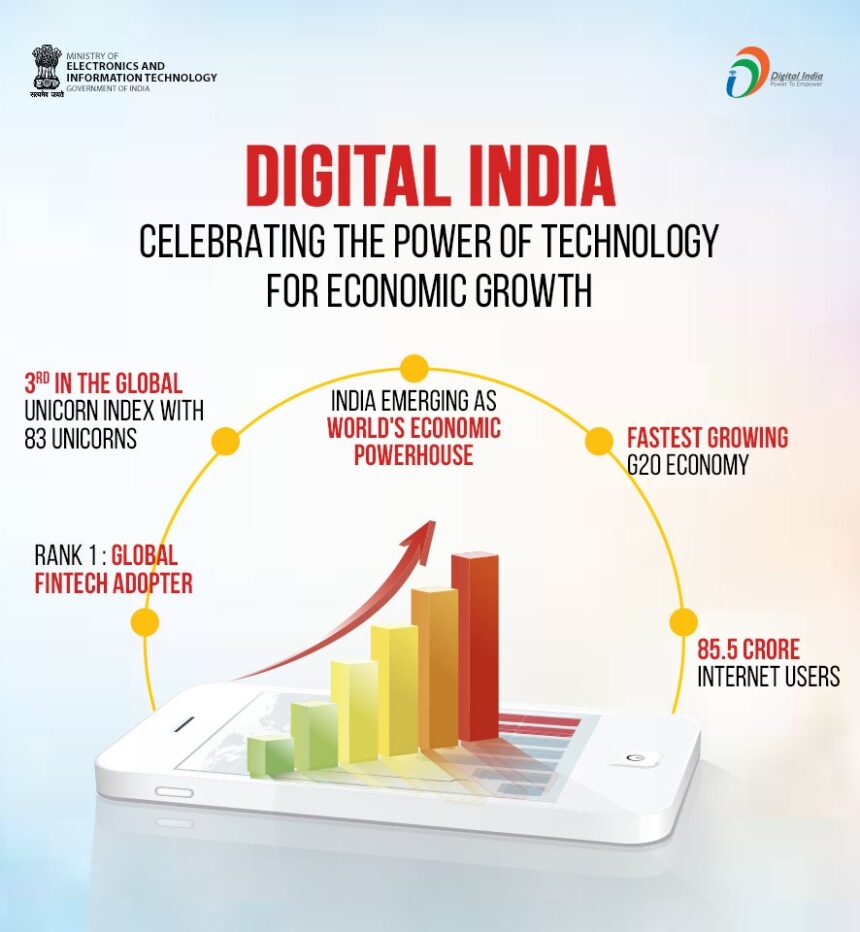
How India’s Digital Economy Is Powering Growth in 2025
An in-depth look at the drivers, scale, winners, challenges and what comes next
India’s digital economy in 2025 is no longer an emergent subplot — it’s a headline act. Over the last decade digital technologies moved from novelty to foundation: payment rails, digital identity, affordable smartphones, cheap data and platform marketplaces rewired how Indians buy, sell, work and access public services. In 2025 those pieces are delivering measurable economic value: a larger share of GDP, faster productivity in digitally enabled sectors, new jobs and entirely new business models. This longform post explains how the digital economy is powering growth, which building blocks matter most, who’s benefiting, what risks remain, and where the growth will come from next.
1) The size and scale: digital is already a material slice of India’s GDP
By government estimates and independent studies, India’s digital economy has become a sizeable, measurable contributor to national income. Estimates put the digital economy at about 11.7% of GDP for 2022–23, with forecasts projecting further expansion to roughly 13.4% by 2024–25 as digital adoption deepens across sectors. This growth is driven not only by traditional ICT industries but by the digitalisation of agriculture, retail, finance and public services. MeitY+1
Why this matters: when a growing share of economic activity flows through digital platforms and services, it multiplies productivity effects, enables new forms of trade, and scales services that were previously costly or impossible to deliver at low unit cost.
2) The foundational building blocks: payments, ID, connectivity
Three infrastructure pillars — digital payments, unique digital identity, and broadband/mobile connectivity — are the plumbing that lets myriad apps and businesses function at scale.
Digital payments: UPI and the explosion of low-cost transactions
India’s Unified Payments Interface (UPI) has become the global poster child for fast, low-cost digital payments. Monthly volumes run in the tens of billions of transactions, enabling a huge shift from cash to digital payments for everything from kirana stores to gig workers. That ubiquity lowers frictions for commerce, reduces cash handling costs and opens instant-credit and loyalty models to small merchants. NPCI+1
Digital ID: Aadhaar as a scale multiplier
Aadhaar-linked authentication and digital KYC made it possible to onboard millions of users quickly and securely, unlocking direct benefit transfers, easier account opening, and more trusted e-commerce and lending interactions. Aadhaar authentication volumes surged into the billions in recent years, reflecting how identity at scale enables more efficient public and private services. UIDAI
Connectivity & device penetration
India reached hundreds of millions of internet users by 2025 (DataReportal put internet users at ~806 million early in 2025), and mobile data prices remain among the cheapest globally. Rising penetration in tier-2/tier-3 towns is the engine for the next growth phase — expanding the addressable market for apps, platforms and digital merchants. DataReportal – Global Digital Insights
3) How digital translates into economic growth — the mechanisms
Digital effects on GDP and growth happen through multiple channels:
-
Productivity gains: Digitally enabled firms (from e-commerce merchants to software services) can handle more transactions per employee, lowering unit costs and raising GDP per worker.
-
Market expansion: Platforms connect consumers and suppliers across geographies, opening urban demand to rural suppliers (and vice versa) and increasing total market size.
-
Financial inclusion: Easy payments and digital credit products let micro-enterprises access working capital, invest and scale.
-
Public efficiency: Digital delivery of subsidies, licenses, health records and education reduces leakages and administrative drag — freeing resources for productive uses.
-
New sectors & jobs: Gig work, micro-entrepreneurship, cloud services, SaaS exports and content creation are direct offspring of digital adoption.
Together, these channels create both demand-side expansion (more consumption) and supply-side improvements (higher productivity), which compound rather than merely add.
4) Where the growth is concentrated — sectors leading the charge
Fintech & payments
Fintech captures both the headline metrics (UPI, wallets, neo-banks) and the enabling services (payments gateways, lending-as-a-service). Instant payments mean firms can build subscription models, micro-credit, and embedded finance more easily than before. NPCI statistics show the continuing rise in volumes and institutional adoption of UPI for both P2P and P2M use cases. NPCI
E-commerce & quick commerce
Retail e-commerce continues to expand rapidly as consumption shifts online. Estimates vary by source, but the market size ran into the tens or low hundreds of billions of USD in 2024–25, with high single-digit to double-digit CAGR projections for the rest of the decade. A noteworthy subtrend: quick commerce (10-minute grocery delivery, etc.) ballooned in metro areas and raised funding for startups focused on delivery networks and micro-fulfilment centers. These models—if they become unit-economics positive—could rewire fast consumer goods distribution in India. IBEF+1
SaaS & IT services exports
India’s software services sector continues to export cloud, product engineering and SaaS offerings. With global demand for cloud migration, automation and AI, Indian firms are capturing higher-value work and moving beyond low-margin, labor-arbitrage models to platform and product revenue.
Digital public services & healthtech/edtech
Tele-medicine, digital health records, online learning and government digital services scale faster when the identity and payment layers exist. These verticals improve access and can reduce per-user delivery costs dramatically, particularly for dispersed populations.
5) Who wins — and who risks being left behind
Winners include digitally enabled micro and small merchants who adopt UPI and marketplaces, platform-native startups that scale network effects, and export-oriented software companies. Consumers benefit from lower search and transaction costs, wider choice, and targeted offers.
At-risk groups include small informal businesses that remain cash-only, digitally illiterate citizens (disproportionately elderly or very low-income), and regions with poor last-mile logistics. Policy actions and targeted onboarding programs will determine how quickly these gaps close.
6) Policy & regulation: enabling growth while managing risks
The Indian government and regulators have pursued a mix of enabling and protective policies:
-
Open rails & interoperable systems: UPI’s open architecture encouraged banks, fintechs and apps to plug in rapidly; such openness fosters competition and innovation.
-
Digital public infrastructure (DPI): Standards-based building blocks (identity, payments, data exchange frameworks) reduce duplication and help private firms build on shared foundations.
-
Data protection & privacy: With the expansion of personal data use, regulatory frameworks (and debates) on privacy, user consent and data portability are intensifying — balancing innovation with consumer rights.
-
Competition oversight: As a few large platforms accumulate reach, policy makers are scrutinizing market power, especially where platform rules can lock out smaller players.
The policy tone in 2025 emphasizes building DPI while tightening norms around data use and platform accountability — an approach meant to sustain growth without unchecked concentration.
7) Investment, capital and startup momentum
Capital continued to flow into Indian tech in 2024–25 across fintech, e-commerce, logistics and AI startups. Large funding rounds in quick commerce and fintech show investor appetite for scale and unit-economics experiments. The combination of domestic demand, a growing startup ecosystem and global investor attention means India remains a priority destination for late-stage and growth capital.
8) Challenges and constraints that could slow the momentum
-
Infrastructure gaps: Last-mile logistics, electricity reliability in pockets, and rural broadband still constrain certain categories (perishables, high-frequency services).
-
Digital literacy & trust: Fraud, scams and poor UX can stall adoption among cautious users. Trust is a key adoption vector.
-
Unit economics in new business models: Quick commerce and hyperlocal delivery depend on solving last-mile costs; many models have required continued subsidies to scale.
-
Regulatory uncertainty: Rapidly changing rules on data, cross-border flows and platform governance can unsettle investment decisions if not signposted clearly.
Addressing these requires both private capital and public policy investments—there’s no single fix.
9) The employment question: job creation vs disruption
Digitalisation is a double-edged sword. On the one hand, platforms and tech services create jobs — product development, content creation, logistics, customer support, digital marketing and micro-entrepreneurship. On the other hand, automation and platform efficiencies can reduce demand for rote tasks.
The net effect in India has leaned positive where digital growth creates higher-value roles and enables many to run micro-businesses (kirana owners, delivery partners, freelancers). But targeted reskilling and vocational programs are essential to avoid pockets of displacement.
10) What to watch next: pockets of outsized opportunity
-
Embedded finance: Lenders, insurers and payments integrated into everyday apps (commerce, mobility, retail) will accelerate financial inclusion.
-
Generative AI adoption: SMEs and creative businesses adopting AI tools for content, customer service and process automation can leapfrog productivity barriers.
-
Rural digital entrepreneurship: With better logistics and localized UIs, rural MSMEs could access national markets for the first time at scale.
-
Green & low-carbon digital infrastructure: As data centers and delivery networks scale, energy efficiency and sustainable logistics will become investment priorities.
11) Practical implications for businesses and policymakers
For businesses:
-
Build on open rails (UPI, digital KYC) instead of re-inventing core flows.
-
Focus on unit economics early for convenience and delivery plays.
-
Invest in UX and trust-building (fraud prevention, clear customer support) to expand adoption beyond early adopters.
For policymakers:
-
Prioritise last-mile logistics and rural broadband to widen the market.
-
Provide clarity on data governance to reduce regulatory risk.
-
Support reskilling programs that tie training to real digital job pathways.
12) Conclusion — a digital multiplier for decades to come
By 2025 India’s digital economy is not a boutique sector — it’s an amplifier for the broader economy. Payments, identity and connectivity are lowering friction for transactions, creating new markets, and enabling services that raise productivity across industries. The result is measurable: a growing share of GDP, rising productivity in digitally enabled sectors, and a vibrant startup and fintech ecosystem.
But the path forward is not automatic. Continued growth will require solving last-mile logistics, ensuring inclusive adoption (so the digitally excluded are brought in), clarifying regulatory frameworks and aligning capital with sustainable unit economics. If India navigates these wisely, the digital economy will remain a core engine of growth for years to come — powering new jobs, new businesses, and a more inclusive, productive economy.