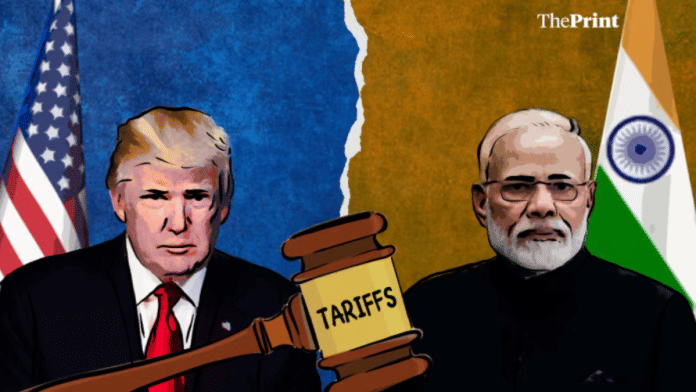
US President Donald Trump had on 2 February announced rolling back the punitive tariff on Indian goods to 18 per cent from 50 per cent in return for an assurance that India would stop purchasing Russian oil.
The Indo-US trade deal, however, is yet to be signed with tough negotiations continuing on both sides. Government sources had Monday said that the Indo-US trade deal will be signed only when the Trump administration its global tariff architecture after an American court struck down the previous reciprocal tariff system in February.
The 2 February announcement by Trump came following almost year-long negotiations after the US imposed reciprocal tariffs of 25 per cent on Indian goods in August 2025. He later introduced an additional tariff of another 25 per cent as a punitive measure as India continued purchasing Russian oil despite sanctions.
The parliamentary panel also observed that though internationally, the prices of crude oil and natural gas have declined over the past few years, in India the prices of petrol, diesel, and cooking gas have been increasing gradually.
“…this situation is adversely affecting trade and commerce in both the domestic and export markets. Further, the recent tensions in the Middle East have raised concerns regarding the availability of crude oil and natural gas, particularly LPG, which has become a pressing concern for the citizens of the country,” the parliamentary panel said while recommending that the government take necessary preventive measures to address these challenges.
The 31-member panel, which included 10 Rajya Sabha and 21 Lok Sabha MPs, has recommended “strengthening of domestic manufacturing capabilities” to reduce dependence on imports particularly in crude oil, gold and electronic components and also focus on capacity-building measures and strengthening supply chain.
“Value addition initiative should be a priority to enhance competitiveness and improve overall trade balance with focus on Make in India and ,” the parliamentary panel said in its report.
The parliamentary panel also took note of India’s widening trade deficit and the stagnation in merchandise exports during 2025–26.
India’s overall trade deficit widened from $78.39 billion in 2023-24 to $94.66 billion in 2024-25, the panel observed. During April-December 2025, the overall trade deficit stood at $92.03 billion, compared to $88.43 billion in the corresponding period of 2024.
It has recommended that the Department of Commerce “may undertake targeted and time-bound measures to enhance export competitiveness and provide focused support to high-potential sectors in order to correct the trade imbalance.”
The panel has also suggested that the Department of Commerce should also undertake strategic diversification of India’s merchandise export basket with a clear shift towards high-value sectors. It also emphasised the need to revitalise labour intensive industries through targeted policy support and effective utilisation of existing schemes.
India’s trade agreement architecture during 2025-26 came in for appreciation from the parliamentary panel, which noted a “significant acceleration” in the process, with the conclusion of landmark agreements with the United Kingdom, New Zealand, and the European Union, and the coming into force of multiple other agreements.
“… these agreements collectively open major new avenues for Indian exporters across goods and services,” the panel noted, recommending that the Department of Commerce establish a dedicated post-implementation monitoring framework for each concluded agreement.
“This framework should provide for systematic tracking of export utilisation rates, assessment of sector-specific gains, and identification of any non-tariff barriers that may hinder the full realisation of negotiated market access,” the panel said.
The panel has recommended that the Department of Commerce should continue to actively pursue enhanced market access improvements for Indian exports to major trading partners where substantial trade imbalances persist.
(Edited by Viny Mishra)