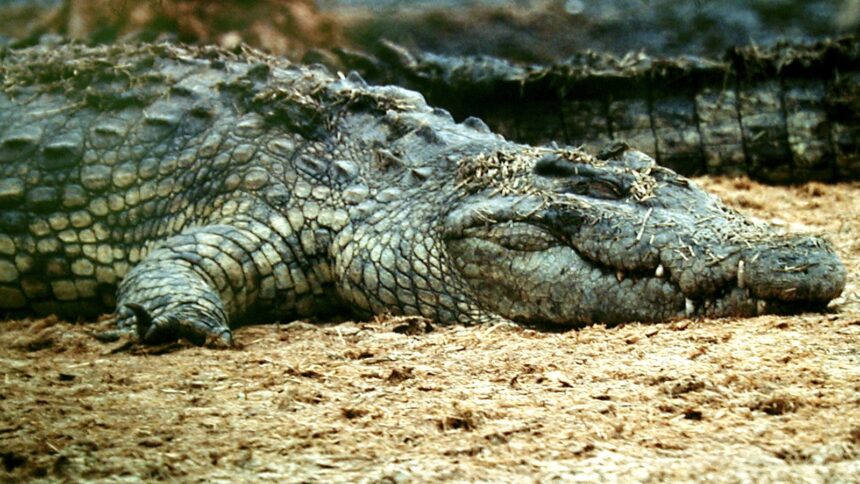
We’ve all heard the saying “sleeping with one eye open” — usually about someone who’s cautious, alert, or just plain paranoid. But for crocodiles, it’s not a metaphor. It’s real. These ancient reptiles can — and often do — rest with one eye wide open. At first glance, it seems eerie. But dig a little deeper, and it’s one of the most fascinating adaptations in the animal kingdom.
So what’s really going on? Are crocodiles ever fully asleep? And how does this behaviour help them survive?
Back in 2015, scientists from La Trobe University in Australia and the Max Planck Institute for Ornithology studied young saltwater crocodiles in a lab setting. When they introduced a person or another crocodile into the room, they observed something incredible: the crocs would lie still, appearing to rest — but one eye remained open and was always facing the “intruder”.
This wasn’t just an accidental blink. It was deliberate.
The explanation? Unihemispheric slow-wave sleep — a brain function that allows one hemisphere of the brain to sleep while the other stays awake. This means a crocodile can literally rest while still monitoring its surroundings with one eye open and one side of its brain fully alert.
This is not though. The same sleep pattern has been observed in dolphins, seals, and even some birds, such as ducks and chickens, according to the BBC. These animals live in environments where staying 100% unaware could mean missing danger — or dinner.
Crocodiles are survivors. They’ve been around for over 200 million years — long before the dinosaurs went extinct — and their physiology reflects that resilience. Being able to sleep with one eye open is just one of the many tricks nature gave them to stay on top of the food chain.
In the wild, crocs aren’t just predators. They’re also prey, especially when young. So it’s vital for them to stay alert. Whether it’s a threat from another croc, a rival predator, or even a human, this one-eyed open sleep helps them detect danger in time to react.
As noted in The Guardian, this kind of sleep likely evolved as a survival mechanism. It lets crocodiles “nap” while still scanning for potential threats or opportunities.
Imagine taking a nap and keeping one half of your brain on lookout duty. That’s essentially what they’re doing.
Now, you might wonder: if crocodiles are only half-sleeping, do they ever fully rest?
The answer is — probably, but selectively. In safer environments (like a secluded area or when they’re floating alone in water), crocodiles may sleep more deeply with both eyes closed and both brain hemispheres resting. But in risky or social environments, they rely on their unihemispheric sleep to stay one step ahead.
Think of it like a night where you’re dozing on a train — one eye on your phone, half-aware of your surroundings. Not ideal for a human long-term, but perfectly suited for a croc trying to avoid becoming dinner or losing a territorial battle.
Absolutely — and not just sometimes. It’s a real, proven phenomenon. Crocodiles can and do sleep with one eye open, using half their brain to stay alert. It’s not a myth or a curiosity — it’s a survival tool backed by evolution and observed in scientific research.
So next time you spot a crocodile resting motionless, don’t assume it’s asleep in the way we understand sleep. One eye might be closed — but the other could very well be watching you.