Green vs. Growth: Navigating India’s Complex Energy Crossroads
India stands at a historic inflection point, grappling with a dilemma that will define its future for generations to come. On one hand, it is an economic powerhouse in the making, with an urgent need to lift hundreds of millions of its citizens into prosperity, a process that is inherently energy-intensive. On the other, it is one of the world’s most climate-vulnerable nations, facing down the devastating consequences of a warming planet while making ambitious international commitments to combat it.
This is the central conflict: the tension between the imperative for rapid economic growth and the necessity of a sustainable, green transition. There is no easy path. To frame this as a simple choice between coal and solar is to misunderstand the profound complexity of India’s energy crossroads. This is a multi-dimensional chess game involving technology, finance, geopolitics, and social justice.
Part 1: The Twin Imperatives – The Unyielding Pressure to Grow and the Moral Duty to Go Green
The Growth Imperative: Fueling the Ascent
India is the world’s fifth-largest economy and aims to become a developed nation by 2047. This trajectory is built on a foundation of energy.
-
Industrialization & Urbanization: Manufacturing, construction, and transportation—the pillars of growth—are voracious consumers of power. The government’s “Make in India” initiative alone will exponentially increase industrial energy demand.
-
Electrifying Aspirations: As incomes rise, so does consumption. From air conditioners in sweltering summers to electric vehicles and digital devices, the per capita energy consumption of 1.4 billion people is set to soar. Nearly 100% of village electrification does not mean 24/7 power for all, and closing that reliability gap requires massive additional capacity.
-
The Employment Engine: The coal sector alone employs nearly 4 million people, both directly and indirectly. It is the economic lifeblood of several states, including Jharkhand, Chhattisgarh, and Odisha. A rapid, unplanned transition away from coal could trigger severe social unrest and economic dislocation.
The Green Imperative: A Vulnerability and a Commitment
Simultaneously, the pressure to go green is immense and comes from both within and outside its borders.
-
Extreme Climate Vulnerability: India is disproportionately affected by climate change. From devastating floods in Kerala and Uttarakhand to prolonged droughts in Maharashtra and crippling heatwaves across the north, the economic and human cost of inaction is already staggering. Water scarcity and crop failure are existential threats.
-
The Panchamrit Pledge: At COP26, Prime Minister Modi announced ambitious “Panchamrit” (five nectar elements) goals:
-
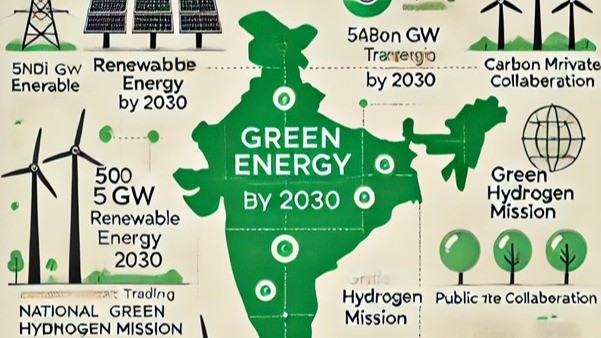
Reach 500 GW of non-fossil fuel energy capacity by 2030.
-
Meet 50% of energy requirements from renewables by 2030.
-
Reduce total projected carbon emissions by 1 billion tonnes by 2030.
-
Reduce the carbon intensity of the economy to less than 45% by 2030.
-
Achieve net-zero emissions by 2070.
-
-
Global Geopolitics & Finance: Access to global green finance, technology transfer, and a seat at the high table of international diplomacy are increasingly tied to a country’s climate ambition. India is positioning itself as a global climate leader, but this role demands demonstrable action.
Part 2: The Current Energy Landscape – A Schizophrenic Reality
India’s energy mix today reflects its dual challenge. It is a tale of two parallel energy systems running at breakneck speed.
The Green Acceleration: A Renewable Energy Juggernaut
India’s progress in renewables has been nothing short of remarkable.
-
Solar Power’s Meteoric Rise: From a negligible capacity a decade ago, India has surged to become one of the top five solar markets in the world. Massive solar parks, like the Bhadla Solar Park in Rajasthan, are among the largest on the planet. Rooftop solar and innovative models like the PM-KUSUM scheme for farmers are driving decentralized generation.
-
Wind and Beyond: Wind power continues to expand, and new frontiers like hybrid (solar-wind) projects and floating solar are being actively explored.
-
The “Power of One Sun”: The International Solar Alliance (ISA), initiated by India, is a testament to its commitment to leading the global solar revolution.
The Inconvenient Anchor: Coal’s Unshakeable Dominance
Despite the green headlines, coal remains the undisputed king, accounting for over 70% of India’s electricity generation.
-
The Baseload Backbone: Renewable energy is intermittent—the sun doesn’t always shine, and the wind doesn’t always blow. Until large-scale, affordable storage solutions are widely available, coal provides the critical, reliable baseload power that keeps the grid stable and the factories running.
-
A Self-Reliance Strategy: India has vast domestic coal reserves. Relying on them is seen as a strategic imperative for energy security, insulating the economy from volatile global oil and gas prices, as starkly demonstrated by the Ukraine conflict.
-
Expansion Continues: Contrary to the global narrative, India is still expanding its coal fleet. The government has identified new coal mine blocks and is building new power plants, arguing they are more efficient and necessary to meet near-term demand.
This is the core of India’s schizophrenia: it is simultaneously one of the world’s largest installers of renewable energy and one of the largest consumers of coal.
Part 3: The Path Forward – Bridging the Chasm with Innovation and Investment
Navigating the crossroads requires a multi-pronged strategy that goes beyond simply adding more solar panels.
1. The Green Hydrogen Gambit
Green hydrogen—produced by splitting water using renewable electricity—is seen as a potential silver bullet for decarbonizing “hard-to-abate” sectors.
-
The National Green Hydrogen Mission: With an outlay of over ₹19,000 crore, the mission aims to make India a global hub for the production and export of green hydrogen.
-
Potential Impact: It could potentially clean up industries like steel, cement, fertilizers, and long-haul transportation, which are difficult to electrify directly. Success here could decouple industrial growth from carbon emissions.
2. The Energy Storage Imperative
The renewable revolution cannot be completed without solving the storage problem.
-
Pumped Hydro: The government is reviving interest in this proven, large-scale storage technology.
-
Battery Energy Storage Systems (BESS): Costs for lithium-ion batteries are falling, and India is aggressively pursuing production-linked incentive (PLI) schemes to become a manufacturing hub for advanced chemistry cell batteries. Exploring alternative chemistries, like sodium-ion, is also crucial to avoid dependency on imported lithium.
3. Modernizing the Grid and Managing Demand
The grid itself must evolve from a one-way street to a smart, interactive network.
-
Smart Grids: Implementing smart meters and advanced grid management systems can help balance supply and demand, integrate renewables more efficiently, and reduce transmission losses.
-
Energy Efficiency: The “cheapest energy is the energy you don’t use.” Aggressive programs for efficient appliances (like UJALA for LEDs), building codes, and industrial energy efficiency can dramatically reduce demand growth.
Part 4: The Human Cost – The Unseen Battle of the Energy Transition
This transition is not just technological; it is profoundly social. A just transition is arguably as important as a green one.
-
Coal-Dependent Communities: Millions of livelihoods in coal-mining regions are at stake. A phase-down of coal must be accompanied by massive reskilling programs and investment in new industries in these regions to prevent creating “ghost towns” and social unrest.
-
Land Rights and Conflicts: Large-scale renewable projects and new transmission lines require vast tracts of land, often leading to disputes with local communities and farmers. A transparent and equitable land acquisition process is critical.
-
The Distributed Opportunity: Decentralized renewables—like rooftop solar and micro-grids—offer a path to not only clean energy but also energy democracy, empowering rural communities and creating local jobs.
Conclusion: The Third Way – A Synergistic, Not Sacrificial, Future
The “Green vs. Growth” framework is, in many ways, a false dichotomy. The choice is not between prosperity and planet. For India, the only viable path is to pursue them in tandem.
The nation’s strategy appears to be a pragmatic, three-stage approach:
-
Maximize Renewables: Aggressively scale solar, wind, and other renewables to meet incremental demand.
-
Use Coal as a Bridge: Continue to rely on domestic coal for baseload power and grid stability, while focusing on improving the efficiency of existing plants and exploring carbon capture technologies.
-
Bet on the Future: Heavily invest in R&D and deployment of game-changers like green hydrogen and advanced storage to ultimately replace fossil fuels.
This is not a lack of commitment, but a recognition of immense complexity. India’s energy transition will be longer, more complex, and more nuanced than that of the developed world. It must write its own playbook.
The world has a stake in India’s success. If a democracy of 1.4 billion people can successfully decarbonize while developing, it will provide a model for the entire Global South. The challenge is Herculean, but the outcome will determine not just India’s future, but the health of the entire planet. The crossroads is not an endpoint; it is the beginning of the most critical journey the nation will ever undertake.