Kolkata and its nouvelle cuisine are suddenly all over the news. People have discovered the wonder of Sienna Café, a 10-year-old restaurant in a 100-year-old building that uses very local ingredients to create truly innovative dishes.
What the restaurant refers to as their Bengal-to-Table menu and their new bar, Bar-a-Bari (which translates to ‘a little too much’), serves “Bengal-forward” cocktails. I’m not sure if this is a response to people discovering the beauty of local ingredients, thanks to Naar, a restaurant in Himachal Pradesh’s Kasauli. Naar had the honour of catering a state dinner at Rashtrapati Bhavan, where it showcased unique dishes made from very common local ingredients, such as nettles.
Regardless of the reason, I believe that the acknowledgement of has been overdue.
For old timers like me, when I visit , I usually go to the usual haunts: Mocambo for the deviled crab to complain that it has more mushrooms than crab, Golden Joy for the perfect Tangra cuisine, Shiraz for mutton biryani, and Eau Chew for some more Chinese food. But we all must live a little. So this time around, I decided to give the relatively new kids on the block, compared to these restaurants, some of which have been around since pre-Independence, a try.
I have visited Sienna Café once before, when the food didn’t wow me, and when they didn’t have a liquor licence. Don’t get me wrong, the food was interesting, but the portions were a little too small for my liking – at that price point – and while innovative, nothing jumped out at me. This time around, though, I have to say, Sienna did not disappoint when it came to the food – the speed of the kitchen had the opposite effect on me, which I will get to later.
The restaurant itself is very chic, located opposite the Byloom store, which has stunning sarees and textiles in the residential neighbourhood of Hindustan Park. The locality is today dotted with multiple quaint coffee shops and restaurants housed in repurposed old Bengali bungalows. Sienna, though, was one of the first movers in the area.
Large French windows look out onto the cosy residential lanes; the walls inside are a textured grey; the lighting is soft but bright enough to see your food; and the seating is comfortable enough to invite you to linger over a meal.
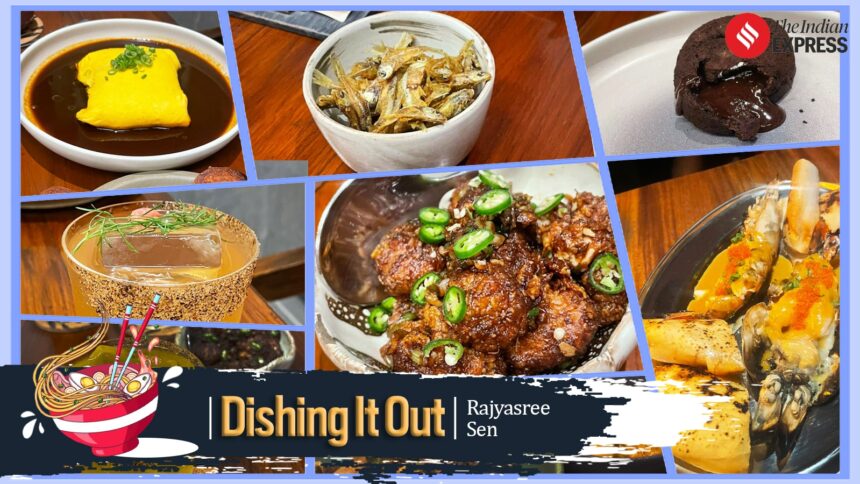
What caught my interest, eye, and taste buds at both Sienna Café, the small bar Nutcase, and the newest entrant into Kolkata’s food scene, Yokocho, helmed by Sienna’s former chef, is the commitment to actually using local, very affordable ingredients. All of them serve a version of Mourola Bhaja, which are whitebait or anchovies, and in Nutcase’s case, Kaanchki fish. These tiny little fish are deep-fried and eaten whole, head and tail and teeny crisp little body.
This is a preparation that Bengali homes serve very often , given that it is one of the most affordable fish to buy. Who would have thought it would make the perfect bar bite?
I’m not a fan of offal, especially slithery brain, but Sienna’s Brain Chilli Fry was a very clever preparation of Brain cut into small chunks and cooked in the same manner in which Kolkata Chilli Chicken is. Dry, tossed with soy, green chilis, and I would reckon a dash of MSG. If you’re a fan of brain or chilli chicken, this is the dish for you.
Of the mains, the Ros Omelette was actually quite delicious. A silken, cheesy, thin omelette was folded like an envelope over slow-cooked confit mutton shoulder and set on a bed of rich bone marrow jhol, or broth. This was served with thick, soft, buttered toast, which you dipped in the broth. The only problem was that nowhere on the menu was it mentioned that mutton was used in the dish, and my friend, who has an aversion to mutton, is the one who ordered it.
My Pork Kalo Jeere Kakuni served with Radhatilak rice was tasty. Pork belly was served with a nigella seed base along with a bowl of rice. Radhatilak rice is a small-grained rice similar to Gobindobhog, with a distinct fragrance of its own. The tabak maaz, which I recommended to my friends, was fine – but took one-and-a-half hours to reach the table, along with the Ros Omelette, by which time we felt the lamb must have lost its way on the way to Kolkata from Kashmir. Slow kitchen service aside, the cocktails deserve special mention.
This is where I think Kolkata’s new restaurants and bars have aced the game. Local ingredients, innovative pairings that work and a healthy pour are a winning combination. The Bhaat AND Bitters used rum, radhatilak rice, mirin, and aromatic bitters, and had a clear bhaat (rice) flavour that coated your tongue. My Tepari Margarita, made with tequila, gooseberry (Tepari), citrus and saline, won me over to becoming a fan of gooseberry with its tart but sweet flavours.
The Koromcha Picante blends Indian olives, or Koromcha, which are usually sour and tart, with tequila, roasted and crushed spices, or bhaja moshla, and citrus. The Chilli Coriander Picante was a great take on the Picante with its tequila, coriander, green chilli, and lime. They were fresh-tasting, good-looking cocktails, served in practical glasses, garnished simply and beautifully. A proper celebration of flavours.
The trauma of the arduous wait for the Ros Omelette and the Tabak Maaz – we almost got knocked out of the dining slot of 7-9 pm thanks to the kitchen’s tardiness – was slightly assuaged by a really spectacular Kancha Lonka Ice Cream with a Dark Chocolate Mud Pie. The sharpness of the green chilli was the Kancha Lonka Ice Cream, which acted as a perfect foil for the Mud Pie.
Despite the long wait and the lack of either a complimentary snack to help pass the time or a dessert to make up for the delay in serving half the table, then the other half after an hour, Sienna is definitely worth a visit at least once. The ingredients used, the pairings, and the cocktails are unique – especially when you come from or , where innovation is frankly missing. But then there’s only so much you can do with butter chicken. The prices aren’t low, but at least you’re paying for something truly different from the usual fare.
Yokocho, the other new restaurant and bar we tried, is a story for another day. But it was a truly praiseworthy celebration of local, commonplace ingredients like Begun Pora – burnt brinjal – and the Bengali love for not wasting vegetable peels and scraps, served on a bed of whipped, silken tofu. Along with some of the finest sashimi I’ve had in a while. And cocktails, which are truly on the ball.
Has Kolkata’s bar and restaurant scene come of age, dishing up imaginative, well-priced delicacies in restaurants that look like they could be in Tokyo or Manhattan, alongside our old biryani and “continental” favourites? I think so. Come to Kolkata for innovative cuisine, stay for comfort food.
Next week, I’ll be writing about the evolution of the wedding feast—from the days when we were young and marriageable to now, when our children are of marriageable age.