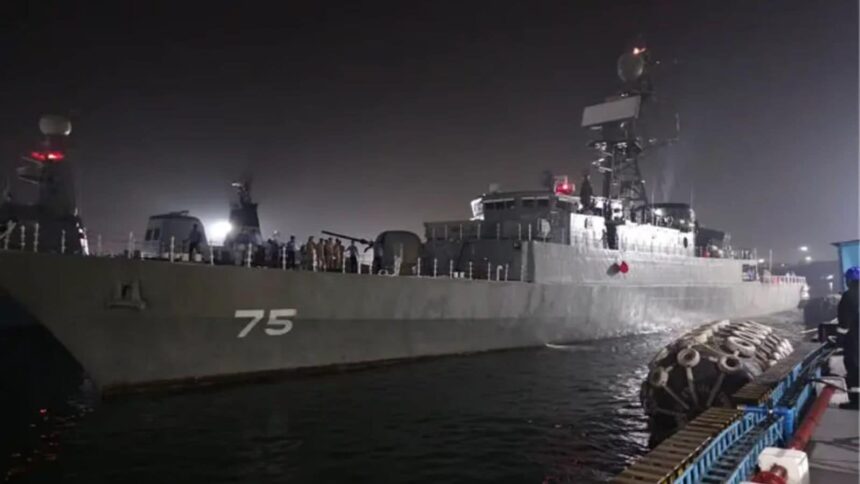
A day after a United States submarine torpedoed and , a second Iranian warship was reported to be waiting just outside Sri Lanka’s territorial waters, deepening diplomatic and security tensions around an incident that has already claimed dozens of lives.
Sri Lankan authorities confirmed on Thursday that the vessel was positioned within the country’s Exclusive Economic Zone (EEZ), awaiting a decision on whether it would be allowed to enter port for assistance. Government spokesman and media minister Nalinda Jayatissa told Parliament that the government was deliberating its next steps while prioritising humanitarian concerns.
“We are aware of it and are contemplating action to safeguard all lives on board,” Jayatissa said. “We are intervening to resolve this issue to safeguard regional peace.”
The unfolding situation comes after the Iranian frigate IRIS Dena, a Moudge-class warship from Iran’s Southern Fleet, was sunk by a torpedo fired from a US submarine on Wednesday morning while sailing roughly 40 nautical miles south of Galle, outside Sri Lanka’s territorial waters but within its EEZ. US War Secretary Pete Hegseth publicly confirmed that the United States carried out the attack. The frigate was returning from a naval exercise hosted by India.
The strike marked a rare naval confrontation in the Indian Ocean. The US government claimed that it was the first time since the Second World War that the United States had targeted an enemy vessel in those waters.
Sri Lankan authorities said they first received an emergency message at 5.08 am from the distressed vessel, which had about 180 crew members on board. The vessel had sunk completely by the time aerial surveillance arrived, leaving only an oil slick floating on the water.
In Sri Lanka’s Parliament on Thursday, opposition politicians pressed the government over whether the Iranian warship had earlier sought permission to enter Sri Lankan waters. SJB Member of Parliament Mujeebur Rahman questioned why the vessel had been forced to wait for hours offshore. “The vessel waited for 11 hours about 40 nautical miles off Galle port for permission from the Sri Lankan government to berth, as it had difficulties returning to Iran due to the conflict situation,” Rahman said in Parliament.
Speaking to The , Rahman said the delay raised troubling questions about whether geopolitical pressure had influenced the government’s decision.
“The ship that was attacked by a US submarine waited for 11 hours seeking entry into Sri Lankan waters,” he said. “Did Sri Lankan authorities delay permission owing to pressure from the US and India?”
His remarks reflected a growing domestic debate in Sri Lanka over whether the government had been caught between competing geopolitical pressures as tensions escalated across the Middle East.
The situation grew more complicated on Thursday after reports emerged that another Iranian naval vessel carrying more than 100 crew members was approaching Sri Lanka’s maritime zone. According to the government, the ship is currently positioned within Sri Lanka’s EEZ but outside its territorial waters, which extend 12 nautical miles from the coast.
Opposition leader Sajith Premadasa raised the issue in Parliament, warning that the presence of another Iranian vessel near Colombo had created a sensitive diplomatic situation. Jayatissa responded that the government possessed more information than had been made public and that a detailed report would be presented to Parliament after the situation stabilised. “We are closely monitoring the developments,” he said.
Former minister Namal Rajapaksa, a senior opposition figure and the son of the former President Mahinda Rajapaksa, urged the government to clarify its position quickly. He pointed to a precedent set during the 1971 Bangladesh Liberation War, when Sri Lanka allowed a Pakistani aircraft to refuel on humanitarian grounds after India closed its airspace. “If the government is unable to decide, it should follow the precedent of neutrality established by Sirimavo Bandaranaike,” Rajapaksa said.
When contacted, the Iranian embassy in Colombo said it was awaiting details from Sri Lankan authorities regarding the sequence of events surrounding the Wednesday morning attack and the circumstances before and after the sinking of the frigate.
In Galle, local residents and civil society groups stepped in to assist the survivors on Wednesday. The Galle Cancer Society, along with community volunteers, provided clothing, food and other essential supplies to the rescued sailors receiving treatment at the hospital.