Today, more than 50 senior officials of Bengal, including District Magistrates and Superintendents of Police, have been transferred.
Not routine. Not neutral. Nothing but raw, centralised flaunting of power at a politically sensitive pre-election moment by the so-called “election watchdog.”
The message is unmistakable: Bengal will be ‘disciplined’, Bengal’s administrative machinery will be crippled, and in Bengal, the Election Commission will act not as a neutral umpire, but as an enforcer. Bengal is the target. Why? Because TMC-ruled Bengal has repeatedly defeated the ruling BJP in a series of elections post-2012. Now the BJP-EC combine wants to defeat Mamata Banerjee at any cost.
Under Article 324, the Election Commission is entrusted with the “superintendence, direction and control” of elections. But that power is not absolute—it is conditioned by constitutional morality, federal balance, and judicial interpretation.
The Supreme Court has repeatedly clarified the limits and purpose of this power. In PUCL vs Union of India (2003), the Court held that the right to vote is an expression protected under Article 19(1)(a) and citizens have a right to obtain information about political candidates. Association for Democratic Reforms (ADR) vs Union of India (2002) placed transparency at the heart of elections. And in the Anoop Baranwal vs Union of India (2023), the apex court warned against executive capture of the Election Commission, emphasising that independence is the lifeblood of electoral democracy. This landmark judgment was overridden by the Chief Election Commissioner and Other Election Commissioners Act 2023 by which the Narendra Modi government removed the Chief Justice from the selection panel of election commissioners and replaced the CJI with a cabinet minister.
In a democracy, perception is not incidental—it is everything. The credibility of elections rests not only on fairness but on the public belief in that fairness. When that belief erodes, the damage is not procedural; it is existential.
The doctrine is clear: Free and fair elections, conducted by an independent and neutral body, form part of the Basic Structure of the Constitution.
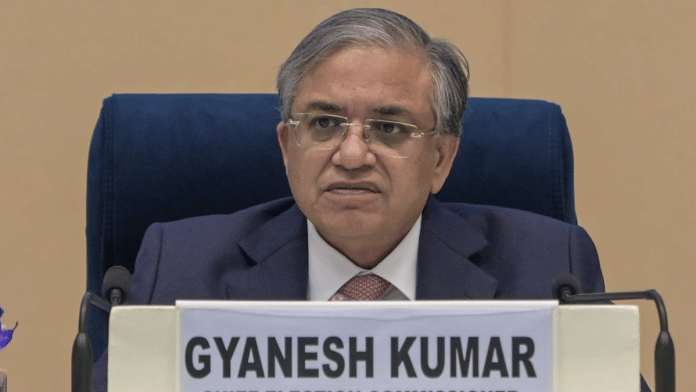
It is against this doctrine that Gyanesh Kumar’s tenure must be judged. And Kumar fails the test. One hundred and ninety-three MPs have signed a notice seeking the impeachment of CEC Gyanesh Kumar. The motion is yet to be introduced in Parliament.
The reasons are glaring, the CEC’s mistakes egregious. We are not expressing routine dissent; we are ringing an institutional alarm bell.
The 4 am purge is not an isolated incident. It is part of a pattern of coercive intervention, particularly in Bengal and across Opposition-ruled states. It raises a fundamental question: Under what legal standard are such sweeping removals justified? Where is the recorded reasoning? Where is the test of necessity and proportionality?
Extraordinary power demands extraordinary justification. None has been offered. Instead, what we see is arbitrariness—precisely what Article 14 forbids.
There are other reasons why CEC Gyanesh Kumar should be impeached.
One is the manner in which the Special Intensive Revision (SIR) exercise has been conducted. In 2002, the SIR took a full year; in 2025-2026, it was rushed through in months.
What should have been a routine update of electoral rolls has transformed into a mass exercise in administrative suspicion.
Lakhs of citizens have been deleted, placed on “logical discrepancy list”, and now on “adjudication lists”. Doubts have been cast on individuals like Nobel laureate Amartya Sen, former Bengal Chief Secretary IAS officer Nandini Chakravorty, Bengal minister for Women and Child Development Dr Shashi Panja, Bengal’s star cricketers Richa Ghosh and Mohammad Shami. Elderly voters with mobility and health concerns have been dragged across distances to hearings.
The SIR exercise has become a regime of documentary terror. Demanding impossibly obscure papers, dismissing and then accepting the Aadhar card, arbitrarily dismissing examination admit cards, leaving citizens trapped in a maze of shifting rules, uncertainty and fear about their right to exist on the rolls.
Burdened with inhuman pressures and deadlines, many Booth Level Officers (BLOs) were pushed to the brink and died by suicide. The has risen to over 100, among them BLOs, citizens and the elderly. Does the EC not have blood on its hands?
The constitutional violation is stark. The burden of proof has been inverted. Citizens are being asked to prove their citizenship and eligibility to vote. This directly contradicts the principle laid down in the PUCL case—that voting is a constitutional expression, not a privilege to be conditionally granted.
The Election Commission is not a citizenship tribunal. It cannot assume powers it does not possess. SIR has ceased to be electoral revision. It is disenfranchisement through administrative design and intimidation masquerading as procedure. Through the brutal SIR process, we did not hear a single word of sympathy or empathy from the EC—the constitutional body that is supposed to safeguard citizens.
Equally troubling is the complete breakdown of dialogue between the EC and elected parties. Bengal Chief Minister Mamata Banerjee has written several letters to Kumar. All of them have gone unanswered. Does a three-time Chief Minister not even deserve an official answer?
The Election Commission is not a sovereign island. It is a constitutional body that must command trust across the political spectrum. Yet, under Kumar, Opposition parties have been systematically excluded, dismissed, and even ridiculed, and there has been no meaningful consultation, no effort to build consensus.
The implicit message is stark. The Opposition does not matter. When an Opposition leader raised anomalies in electoral rolls, he was told to give his complaints in writing, “under oath”, and stop spreading lies. Is this the language the EC should use? The Election Commission is a referee, not a prosecutor. Its authority derives from impartiality, not intimidation.
Tone matters in public life. Institutional authority demands restraint, dignity, and balance. Former Chief Election Commissioner TN Seshan was feared, formidable, and famously outspoken—but he was never partisan. He did not speak differently to the government and the Opposition. In contrast, Kumar’s public posture has often been marked by a certain cavalier disdain, even disrespect towards the Opposition.
Another important reason in the case for the dismissal of the CEC: Prime Minister Narendra Modi concluded his election rallies across poll-bound Kerala, Tamil Nadu, Assam and Bengal on 14 March. Twenty-four hours after the rallies were concluded, the EC announced election dates. Almost as if it were waiting for the PM to complete his travels.
The election calendar itself deepens these concerns. When Opposition-strong states are compressed into single-phase elections—all states in which the Congress is a contender—Assam, Kerala and Tamil Nadu are being held on the same day, the perception of bias becomes unavoidable.
The question arises: Does the government provide the election timetable to the EC according to the campaign schedule of the Prime Minister?
Another matter of concern: Kumar was a member of the Election Commission during the 2024 General Elections. In this election, the EC’s conduct fell alarmingly short. Narendra Modi’s speeches during the 2024 campaign often ventilated deplorable hate speech, particularly his infamous “they-will-snatch-away-your mangalsutra” in Rajasthan. Under the Model Code of Conduct, such statements warranted immediate scrutiny and a firm notice. Yet the Election Commission’s response was conspicuously absent. Beyond an innocuously worded letter to then BJP party president JP Nadda, not a single notice to Modi. Not a word of censure. Silence, in such moments, is not neutrality—it is complicity. This silence is also constitutionally significant. It violates the guarantee of equality under Article 14.
The manner of Kumar’s appointment further undermines confidence. In the Anoop Baranwal case, the Supreme Court sought to insulate the Election Commission from executive dominance. Kumar’s appointment, instead of being transparent and consultative, appeared opaque and hurried, overriding the objections of the Leader of the Opposition. Kumar’s prior proximity to the political executive—having served as Cooperation Secretary under Home Minister Amit Shah—raises questions about independence.
Institutions are not judged only by what they do, but also by how they are seen to be constituted. The Court has repeatedly warned against the concentration of power. Institutional independence cannot survive if appointments are politically curated.
The Election Commission’s decision to limit CCTV footage retention to 50 days is equally suspect. In the ADR case, the Supreme Court emphasised transparency as foundational to electoral integrity. Curtailing access to video records undermines that principle. The justification offered by Kumar to not share CCTV footage of polling booths—invoking concerns about “our mothers and sisters” is not only weak but evasive. Why does the gender of a voter matter? Women voters are constitutional actors, not feminised rhetorical shields for opacity. Kumar infantilised women voters and used them as an excuse to avoid accountability.
The public behaviour of the CEC also raises questions. On his recent visit to Kolkata, Kumar emerged from the airport theatrically waving to crowds and then proceeded to visit religious sites during an official tour—these are not appropriate acts given the election context.
Constitutional authority demands discipline and distance. In a surcharged political atmosphere, optics matter because they shape trust.
Taken together, Gyanesh Kumar’s actions represent a systematic erosion of constitutional guarantees:
Gyanesh Kumar is not guilty of only administrative excess. He has been a constitutional failure.
Impeachment is not a partisan tool nor a weapon of personal vendetta. It is a constitutional remedy—invoked when an office-bearer’s conduct threatens the integrity of the institution they occupy. Impeachment is not political theatre but a move to reinstall democracy’s guardrails.
The Republic cannot function with a compromised umpire. Elections cannot be credible if the referee is in question, bent on demolishing the level playing field. And democracy cannot survive if the voter is treated as a suspect. Kumar’s tenure has raised too many questions, triggered too many doubts, and crossed too many lines. The cost of inaction is simply too high. Therefore, constitutionally and unequivocally, CEC Gyanesh Kumar must go.
(Edited by Theres Sudeep)