Nonetheless, this is not about the stale Messi-Ronaldo debate. Because, as football pundit Jamie Carragher said, “There was never a debate.” Even if there was a slight argument around the corners, the last nail to the coffin was put in 2022 when Argentina lifted the World Cup.
Messi moved to the US in 2023 and joined Inter Miami from France’s PSG. He rejected the massive, record-breaking offer of and chose Major League Soccer (MLS) instead. Let that sink in. While leaving Europe, Messi cited “a better quality of life” for his family.
But under the veil of family, what Messi did was to quietly move to the US, which is going to co-host the World Cup in June this year. He was not choosing a ‘better life’; instead, he was calculating his next moves to lift another World Cup.
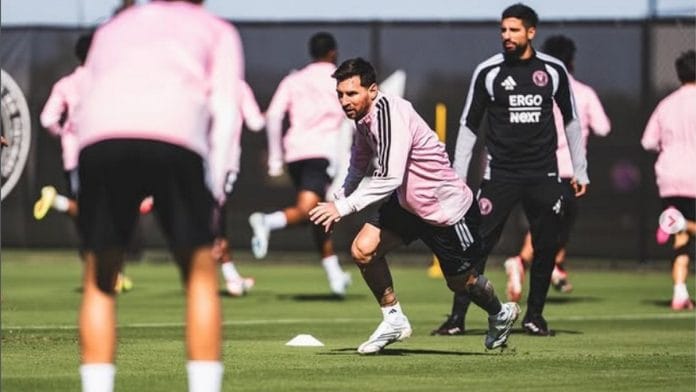
Apart from scoring 81 goals in 93 for The Herons, Messi, who has spent nearly three years in the States, has studied the pitches, got accustomed to the climate, and evaluated the crowds—one of the biggest factors in football.
Like Spanish coach Pep Guardiola has pointed out in the Amazon Prime documentary series : “Messi scans the fields thoroughly. For him, it’s a jungle, and he needs to survive.” In the same series Swedish mathematician David Sumpter said that Messi is as much a mathematician as a footballer.
“Messi’s movement creates geometric patterns. His play can be studied like mathematics and spatial systems. But even with data, he remains impossible to fully explain,” he had said.
And Messi did exactly this. He has played on fields across the US. Now he knows every corner of them. He knows the exact depth of the grass and can use it to his advantage.
Messi uses spatial intelligence to dominate the game. Even when he appears to be “walking”, which can often be seen, he’s actually gathering data—measuring distances between defenders and identifying the exact pockets of space he can exploit. By the time he receives the ball, he’s already solved the “equation” of the defence.
The second important thing is to get acclimatised to the weather. Since the World Cup is scheduled from June to July, the temperature in host cities is expected to hover between 15°C and 38°C. A difference of 23°C becomes a tad too much on the football field, especially for players from European countries.
However, Messi, who would surely play the role of a deep-lying playmaker or an ‘offensive architect’, has already weathered such conditions. From playing in the snow to a scorching sunny day, Messi has experienced it all in the US.
Now, coming to the most crucial point—crowds and fans. Let us first conclude that the Americans love Messi. Football in the US, popularly known as soccer, was not followed much until Messi joined its top-tier league. He was like a messiah to the country when it came to the sport.
Messi’s arrival caused a seismic shift in MLS, dramatically boosting league-wide viewership, attendance, sponsorship income, and global popularity. He delivered immediate success for his club, winning the Leagues Cup and Supporters’ Shield, while driving ticket prices up by as much as
Average MLS attendance increased by nearly 20 per cent after his debut, and Apple TV’s MLS Season Pass subscriptions roughly doubled within his first few months. Inter Miami saw massive social media growth (over 14 million new followers). Road matches became sellout events, with stadium attendance averaging 23,234, a league record.
A crowd’s cheering chants can become the most crucial factor in a football match. It is the crowd that boosts the morale of the players. And Messi has already earned it. The Americans would vouch for Messi, irrespective of the opponent, and yes, that includes the US, too. Because he is the reason behind the growth of American soccer.
Hence, playing a World Cup in the US would be like a second home for Argentina this year.
The little boy from Rosario didn’t stop here. Apart from scanning fields and earning the crowd’s love, Messi has successfully siphoned a few Argentines into the Inter Miami squad. The biggest signing was central midfielder Rodrigo De Paul, who was a crucial player in the 2022 World Cup.
With him and De Paul controlling the game from midfield, Messi made sure the coordination improved in these three years. And, we all know, a strong midfield is the best thing a team can bet on. It bridges the play between the defence and the attack.
There are other notable Argentine players in the team, too. Defender Facundo Mura, winger Tadeo Allende, young forward Mateo Silvetti, and coach Javier Mascherano are all Argentines.
So, when Messi makes a move, be aware. He isn’t just taking chances. He is calculating, building a stronger chance for Argentina to lift the World Cup once again in 2026.
(Edited by Asavari Singh)