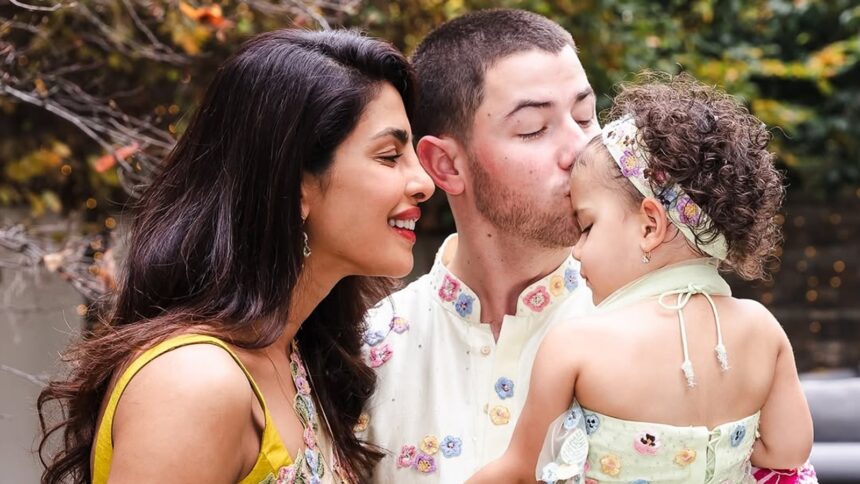
Raising children in an increasingly digital and hyperconnected world has introduced new challenges for parents, particularly regarding privacy and safety. Recently, Priyanka Chopra Jonas spoke about why she prefers to keep her daughter, Malti Marie Chopra Jonas, away from the public spotlight for now. Speaking on the podcast hosted by Amanda Hirsch, she explained that as her daughter grows older, she wants to give her as much privacy and normalcy as possible.
Priyanka said that her approach is centred on letting her while still understanding the reality of public curiosity. “As she’s growing older, we’ve started to also kind of just deflect a little bit. She moves around a lot, so we let her have as much anonymity as she can. It is her normal, and people will be curious about her, and I never want her to be fearful of that or judgmental or sceptical of the humans that she meets, because there are good people in the world, and I’ve had wonderful experiences with friends like that. It’s okay for her to be aware of it, but to have a sense of choice, I think, will be important (sic),” she said.
She also shared that concerns about privacy and safety led her to implement certain protective measures. According to Priyanka, an incident in which a stranger followed her home from school while recording her reinforced the importance of being cautious about unwanted attention. Reflecting on this, she explained why security sometimes accompanies them in public. “When we have security out and about, it’s just … to not be recorded without consent because a lot of that happens… I’ve always been of the opinion that I kind of chose a public life… (When) it comes to children, that’s … terrain we are all learning in the last like 10 to 20 years what that is gonna be like in the next 10 years, 15 years for them. So I think a little bit of grace is required for everyone, but also certain awareness of safety and what that means.”
Counselling psychologist Athul Raj tells indianexpress.com, “Children internalise a sense of self when they feel ownership over their lives. In today’s age of viral social media, a single photo can reach thousands within hours, creating exposure that a child may not be equipped to handle emotionally. Giving children the choice to appear in public spaces — or online — reinforces agency, self-respect, and emotional safety. It teaches them that they have control over what others see, and that their comfort is valid.”
He notes that for Indian families, where relatives often share images freely, this principle becomes crucial: a child’s right to privacy is not negotiable, and learning it early lays the foundation for a confident, independent identity.
Children need exposure to the world — playgrounds, social gatherings, public events — but with boundaries that shield them from real harm. This might mean supervising interactions, controlling digital exposure, or negotiating which moments are photographed.
Importantly, Raj stresses, explaining why rules exist fosters trust. “In India, extended families often feel entitled to post or share, which can . Parents who guide with reasoning, rather than simply saying ‘no,’ help children develop judgement and confidence.”
Persistent observation or unsolicited attention can make children anxious, self-conscious, and hesitant to express themselves authentically. They may internalise the idea that their worth is tied to others’ approval, stunting emotional growth.
“Parents can buffer this by validating feelings, offering private spaces for unobserved exploration, and giving children real choice about what is shared publicly. By modelling respect for boundaries, parents teach the child a lifelong lesson: consent is non-negotiable. Over time, children learn to assert themselves confidently, engage socially without fear, and build a resilient sense of self-critical in a world where attention is constant and often uncontrollable,” concludes Raj.