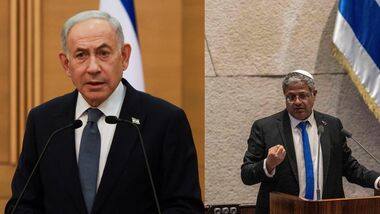
Weeks after Israeli Prime Minister lost the country’s election to his rival, Yashar chairman Gadi Eisenkot, the former is reportedly preparing to offer his rival the position of prime minister in a rotational government, local media reported.
According to The Times of Israel, Netanyahu is willing to serve as the second prime minister. The decision reportedly comes amid ongoing efforts to form a new government. Citing officials in the Prime Minister’s Office, Channel 13 reported on Friday (local time) that Netanyahu is preparing to announce his willingness to enter into a power-sharing agreement with Eisenkot, but officials within the PM’s Office are divided over the proposal.
According to public broadcaster Kan, the proposal has been communicated through informal channels, giving Likud room to deny any involvement, even as the party remains divided over the conditions of a possible deal. Meanwhile, is reportedly highly sceptical of Netanyahu’s offers and is continuing preparations to form a government in the coming week, before his mandate expires on 6 December.
Avigdor Liberman, chairman of Yisrael Beytenu, on Friday (local time) warned that the offer of a rotational partnership from the caretaker prime minister could be a ploy to derail the formation of Eisenkot’s new government. In a post on X, Liberman wrote, “The change government is taking shape,” adding, “I wouldn’t rule out the possibility that [Netanyahu] will offer Gadi Eisenkot a rotation in which Netanyahu would serve second, but everyone needs to understand: this is merely a ploy.”
Liberman further argued that Netanyahu, who is widely known as Bibi, wants another election and will drag out unity talks until the last moment, after which he will find a pretext to break them off. He noted that even if a unity government is established, Netanyahu will attempt to trigger a crisis within months to take the country back to the polls. Concluding his post, Liberman wrote, “All the players in the political arena need to internalize this.”
According to local media reports, Eisenkot has already pledged to his coalition partners, including Democrats chairman Yair Golan and Liberman, that he will not form a unity government with without their approval.
Senior members of Eisenkot’s bloc told Channel 13 that B’Yachad chairman Naftali Bennett, who has publicly advocated a unity government with Likud, plans to vote against an Eisenkot-led administration if it is formed before all avenues for negotiations with Netanyahu have been exhausted. B’Yachad is the only party in Eisenkot’s bloc that has yet to reach a coalition agreement with Yashar.
Earlier on Friday, Bennett said he was prepared to explore other “less desirable” options if coalition talks with Likud failed. He has previously opposed forming a government that includes ultra-Orthodox or Arab parties. Even with Bennett’s party, Eisenkot’s four-party bloc currently holds only 48 seats, well short of the 61-seat majority required to form a government. To bridge the gap, Eisenkot has two options: either rely on the support of Arab-led parties or seek backing from ultra-Orthodox parties in .
Eisenkot’s preferred course for now appears to be a combination of the two options: forming a coalition with both the Haredi United Torah Judaism party and Ra’am, considered the more moderate of the two parties.
Such an arrangement would go against campaign promises made by key members of Eisenkot’s bloc, who had vowed not to join a government with Arab-led or ultra-Orthodox parties. However, the inconclusive election results have forced the parties to consider compromises to prevent another election.
Meanwhile, Channel 12 reported that Ra’am, the country’s Arab-majority party, has offered to back the security decisions of an Eisenkot-led government throughout its proposed four-year term. In return, the party is seeking ministerial portfolios and significant investment in Arab communities.
However, it remains to be seen whether Eisenkot will seek support from Arab parties or have to accept Netanyahu’s offer to form a government before his mandate expires on 6 December.