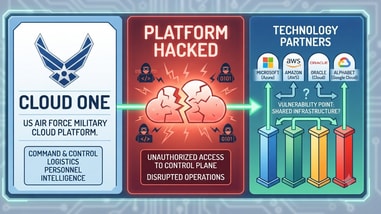
Hackers have breached the US Air Force’s Cloud One computing platform, raising concerns over the security of sensitive military information, including tactical operations, personnel records and logistics data, reported Reuters.
The intrusion, discovered during a system upgrade within the past month, has disrupted operations across the platform, which relies on technology from Microsoft, Amazon, Oracle and Alphabet, according to the report, citing people familiar with the matter.
The identity of the hackers, the full extent of the breach and whether any information was stolen remain unknown. However, the incident has prompted investigators to seek assistance from Cyber Command to assess the potential damage, according to one of the sources.
The breach was detected while work was underway to upgrade Cloud One, with two sources telling as per the report that the discovery had caused disruptions across the system. One of them said the attackers exploited a software vulnerability to gain access to the platform’s control plane, although Reuters could not establish which vulnerability was used.
In response to questions from news agency, the US Air Force said it “does not comment on the security posture, vulnerabilities or operational status of specific networks and systems. We continuously take prudent measures to protect Department (of the Air Force) information, systems and mission capabilities”.
Launched in 2017, Cloud One was designed as a centralised cloud computing platform to meet the US Air Force’s information technology requirements. It brings together infrastructure and services from four major technology companies — Microsoft, Amazon, Oracle and Alphabet — to support numerous military and administrative applications.
The platform supports systems handling a wide range of information, from personnel records and payroll to military logistics and aircraft maintenance.
Among the applications hosted on Cloud One is the Air Force’s Cloud-Based Command and Control system, which brings together air defence radar information and other data feeds from across North America.
Another critical application is the Theater Integrated Combat Munitions System, which monitors bombs and missiles across more than 200 US Air Force locations worldwide.
Cloud One is considered one of the ‘s largest cloud computing platforms, according to two sources cited in the report. One source underlined the seriousness of the incident, saying, “A breach here is a big deal.”
The platform’s prime contractor was Science Applications International Corporation (SAIC) until 2025, when defence technology company Leidos took over the responsibility. SAIC did not respond to Reuters’ request for comment, while Leidos directed questions to the Air Force.
The breach has affected both ongoing operations and planned upgrades involving Cloud One.
According to three people familiar with the matter, efforts to shift additional back-office applications onto the platform have been suspended. The migration had been a longstanding priority for the US military.
Updates to applications already operating on Cloud One have also been blocked, preventing Air Force personnel from installing fixes and security patches. This comes as several serious software vulnerabilities have recently been disclosed across the technology industry.
A fifth source mentioned in the report that administrator privileges had also been withdrawn from some users.
The potential implications of the intrusion are particularly concerning because the attackers may have accessed the platform’s control plane, which manages and oversees cloud infrastructure.
One source compared this component to a universal remote, explaining that access could theoretically allow intruders to examine information about military aircraft operations or the movement of spare parts. However, it remains unclear whether the hackers accessed or used such information.
The incident comes amid growing concerns about cyberattacks targeting American government and military networks, particularly as artificial intelligence tools increase the speed at which attackers can identify and exploit software weaknesses.
The US government has also been dealing with the consequences of several other cyber incidents, including two involving the Federal Bureau of Investigation (), a previous breach of Pentagon data, the exposure of Department of Homeland Security personnel information, an intrusion affecting at least two intelligence agencies and a cyberattack on the Treasury Department.
Cloud One itself has previously faced repeated attempts to penetrate its defences. In a 2023 commentary published by FedScoop, the platform’s leadership claimed it had achieved a “100% success rate” in thwarting what it described as a “staggering” number of intrusion attempts.
“There is no room for error when it comes to security,” Cloud One’s leadership stated at the time.