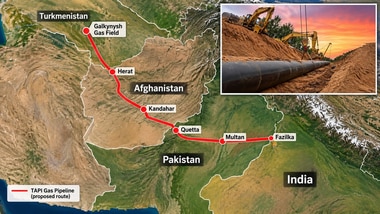
The Turkmenistan-Afghanistan-Pakistan-India (TAPI) gas pipeline, envisioned as a major energy corridor connecting Central Asia with South Asia, has taken another step forward, with construction of its Afghan section advancing towards the city of Herat.
Turkmenistan expects to complete the latest section of the pipeline connecting its border city of Serhetabat with Herat by the end of 2026.
The stretch is expected to begin transporting gas to Afghanistan in early 2027, potentially giving fresh momentum to a project that has remained stalled for years amid geopolitical tensions, security concerns and financing difficulties.
The development is significant for India, which is among the proposed beneficiaries of the ambitious pipeline.
If completed, TAPI could give India access to Turkmenistan’s vast natural gas reserves through Afghanistan and Pakistan, opening an alternative energy corridor to meet its growing demand for natural gas.
The section approaching Herat is only a small part of the proposed 1,800-km pipeline, with the more challenging stretches through Afghanistan and Pakistan yet to be completed.
The TAPI pipeline is a proposed 1,814-km natural gas transportation project connecting Turkmenistan with Afghanistan, Pakistan and India.
It is designed to transport gas from Galkynysh gas field, one of the world’s largest, to energy markets in South Asia.
With a planned annual transportation capacity of 33 billion cubic metres (bcm), the project is estimated to cost around $10 billion.
The pipeline will begin at the Galkynysh gas field in Turkmenistan before crossing Afghanistan and Pakistan to reach in Punjab, close to India’s border with Pakistan.
Its proposed route is divided into three major sections:
– Turkmenistan: Approximately 214 km of pipeline will connect the Galkynysh gas field to the Afghan border.
– Afghanistan: Around 774 km will pass through western and southern Afghanistan, including Herat and Kandahar.
– Pakistan: Approximately 826 km will run through Quetta and Multan before reaching Fazilka in Punjab, India.
Under the proposed gas-sharing arrangement, India and Pakistan are each expected to receive 42% of the transported gas, equivalent to around 14 bcm annually. Afghanistan is allocated the remaining 16%, or approximately 5 bcm, in addition to earning transit fees from the pipeline.
The latest construction activity has brought the project closer to its first operational milestone, although the overall pipeline remains far from completion.
Turkmenistan completed its domestic section of the pipeline in 2019. Construction of the Afghan section formally began in 2024, with work progressing towards Herat.
At the Turkmen Energy Forum in October 2026, Turkmenistan said construction of the Serhetabat-Herat section had reached the outskirts of Herat. The country expects this stretch to be completed by the end of 2026, with gas transportation to the Afghan city expected to begin in early 2027.
According to Reuters, Turkmen officials believe that commissioning this initial section could help attract international lenders and investors for the larger project.
Muhammetmyrat Amanov, head of the Turkmen state company responsible for the TAPI project, told Reuters that the Herat section would help generate early revenue and strengthen confidence among potential lenders.
The approximately 150-km Serhetabat-Herat stretch is estimated to cost $600 million, according to media. Its planned capacity is much smaller than the eventual 33-bcm annual capacity of the complete TAPI pipeline.
The initial gas supplies are also expected to support Afghanistan’s domestic requirements. Plans identified by include connecting the pipeline to the Herat Industrial Park, setting up gas distribution stations and developing a compressed natural gas complex. A private investor has also proposed a gas-fired power plant near Herat.
This could provide an immediate economic incentive for Afghanistan to support the project, even before the pipeline is extended further towards Pakistan and India.
Turkmenistan has some of the world’s largest natural gas reserves, making it an important potential supplier for energy-hungry economies across Asia.
The Central Asian country is estimated to hold around 5.3% of global natural gas reserves, ranking fifth globally after , Iran, Qatar and the United States.
It could also deepen India’s economic engagement with Afghanistan and Central Asia, strengthening regional connectivity through energy infrastructure.
Despite the latest construction progress, the possibility of gas reaching India through Pakistan remains uncertain.
The biggest challenge is the political geography of the pipeline. TAPI must pass through Afghanistan and Pakistan before reaching India, making its successful completion dependent on cooperation among all four participating countries.
The return of the Taliban to power in in 2021 raised questions about security, political recognition and the availability of international financing for infrastructure projects in the country.
Although the Taliban administration has shown interest in the pipeline, security risks and uncertainty over the long-term political environment remain concerns for international investors.
presents another major challenge. India and Pakistan have a history of strained relations, with diplomatic tensions rising after the terror attack and security concerns frequently affecting bilateral cooperation.
is another obstacle. With an estimated project cost of $10 billion, TAPI requires substantial investment and long-term commitments from participating countries and international lenders.