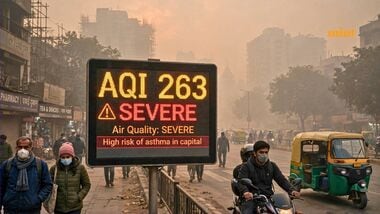
Smoky haze covered Delhi on Thursday, November 26, as air quality reached the severe category. The Air Quality Index (AQI) stood at 263 at 8:41 AM on the US scale. It fell 71 points from the overnight peak of 334. New Delhi ranked 60th among the world’s most polluted cities at the time.
improved through Wednesday afternoon before worsening again in the evening. The AQI fell to 165 at 5:01 PM, its lowest in the previous 24 hours. It rose above 300 before midnight, reaching 334 at 3:31 AM on Thursday. Readings remained above 300 until after 5 AM, then eased later in the morning.
The November calendar shows a reading of 226 for Wednesday, down from 236 on Tuesday. Monday’s reading was higher at 311. The highest daily figure through November 25 was 666 on November 9. The next highest was 547 on November 12. All 14 days in the first fortnight had readings above 300.
Delhi’s seven-day peaked at 532 at 6 AM on November 19. That seven-day period ended on November 25. The lowest reading in that series was 186 at noon on November 25. Early morning readings were above 400 on several days during that stretch. The latest morning reading was roughly half the seven-day peak.
Delhi’s PM10 level was 261 micrograms per cubic metre across the city at 8:41 am. The World Health Organization’s guideline is 45 micrograms per cubic metre.
Delhi’s reading was about 5.8 times that level. The PM10 reading fell in the unhealthy category. The concentration of finer PM2.5 particles was 186 micrograms per cubic metre.
Carbon monoxide stood at 2,214 parts per billion. Nitrogen dioxide measured 20 parts per billion while sulphur dioxide measured six. Ozone was recorded at one part per billion. The temperature was 17°C and humidity was 48%. The wind speed was 5.4 km/h, and the UV index was 0.5.
New Delhi had the highest AQI among 8 Indian metros. It ranked 273rd in that comparison, followed by Kolkata at 256. Pune recorded 198, Mumbai 185 and Ahmedabad 175. Chennai stood at 125. Bengaluru had the lowest reading at 71, followed by Hyderabad at 92.
AQI.in flagged a high risk of asthma symptoms at the reported . The symptoms listed include wheezing, breathlessness, chest tightness and a persistent cough.
It advised people with asthma to stay indoors and keep windows closed to reduce exposure. It also advised against strenuous outdoor activity and exposure to secondhand smoke.