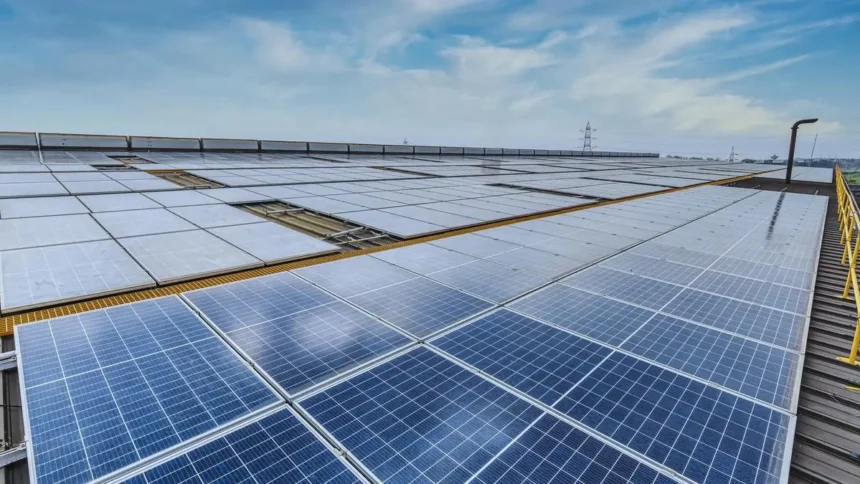
The International Energy Agency (IEA) has pointed to a trend in developing countries in Africa, West Asia and Southeast Asia where there is a significant gap between installed solar power capacity and volumes of panels imported from China, pointing towards a growing reliance on decentralized, or off-grid, solar solutions.
The agency terms the phenomenon as the “missing PV panels” and opined that the scale of this gap indicates that consumers in regions (developing countries) with limited electricity access, or facing daily blackouts of 8-10 hours, are increasingly installing small rooftop or garden systems to improve electricity supply.
“Because these systems are typically not connected to the grid, they are difficult for governments to track and are therefore classified in our dataset as off-grid solar PV,” IEA added.
The West Asia conflict, which erupted on February 20, 2026, also acted as a tailwind for the phenomenon.
For instance, IEA said that amid the disruptions to energy markets from the conflict, solar panel imports from China into Africa, Middle East and Southeast Asia rose sharply during March to May this year, underscoring the growing role solar PV plays in the energy systems of many countries.
The IEA said that the case of “missing PV panels” is most pronounced in Pakistan, where official statistics report only around 10 gigawatt (GW) of installed solar PV capacity as of March 2026, but imports reached nearly 50 GW from 2020 to 2025.
“Although Pakistan exhibits the largest gap compared with Africa and the ASEAN, many developing economies with limited electricity access register a discrepancy of over 50 per cent,” it added.
This trend leads to a significant off-grid solar PV expansion in IEA’s forecast. The pace of growth for 2026-2031 is projected to increase 2.5-fold from 2020-2025, with almost 80 GW of off-grid capacity to be installed through 2031.
Outside of Pakistan’s dynamic off-grid market, Sub-Saharan Africa is set to lead this surge, with more than 21 GW of new installations over 2026-2031, which is equivalent to the region’s total installed capacity today.
In ASEAN, where consumers in countries most affected by the recent energy crisis are turning to off-grid systems to reduce their bills, about 10 GW of additional off-grid capacity is to be installed–-a tenfold increase from current capacity of less than 1 GW, the IEA noted.
Besides, the “missing” solar panels also reflect the complexities of global trade. For instance, some solar PV panels imported from China into developing economies are then re-exported to avoid tariffs in other markets.
Published on November 25, 2026