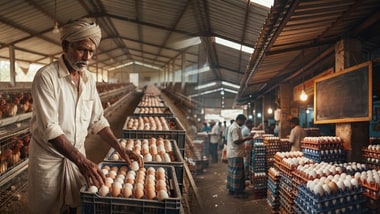
Egg prices have plunged 10%-20% across India over the past 8-10 days as a bird flu outbreak in Tamil Nadu disrupted exports, pushing surplus supplies into the domestic market amid weakening seasonal demand, as per a report.
In Namakkal, Tamil Nadu, India’s poultry hub, egg prices climbed to ₹6.70 apiece on November 11 but fell to ₹5.60 following the confirmation of bird flu in Cuddalore on November 13, marking a decline of nearly 19%, The Times of India reported.
Prices have dropped by more than 15% across most southern states, while Delhi, West Bengal, Gujarat and Maharashtra have recorded relatively smaller declines of 6%-10%, according to TOI.
Namakkal accounts for over 90% of India’s egg exports, and the disruption in shipments has worsened the domestic supply. The region’s daily egg exports, which stood at around one crore during the corresponding period last year, had dwindled, the news outlet said.
The price slump has hit poultry farmers as feed costs remain elevated. Maize prices have risen nearly 50% over the past year, while soybean meal has become around 30% more expensive, further squeezing farmers’ margins, TOI reported, citing industry sources.
Poultry farmers struggling to recover costs amid higher feed prices and reduced demand.
The crisis has also hit chicken producers, with production costs exceeding ₹120 per kg, while farmers are receiving around ₹80 per kg.
Feed manufacturers are also facing mounting losses amid the downturn, with industry representatives warning that the combination of high input costs and depressed poultry prices is threatening the sector’s viability.
Around one lakh chickens have died or been culled following an outbreak of highly pathogenic avian influenza (H5N1) in Tamil Nadu’s Cuddalore district, prompting authorities to intensify containment measures and surveillance to prevent the virus from spreading to humans.
The outbreak was confirmed on November 13 after samples from a poultry farm in Kattiyankuppam, Kurinjipadi taluk, tested positive for H5N1 at the National Institute of High Security Animal Diseases (NIHSAD), Bhopal. Bird deaths were first reported on October 30 in Thamanampatti village, with more than 35,600 birds subsequently dying across 15 farms before confirmation.
A central government team visited the district on Saturday to inspect containment measures, while doctors from the National Centre for Disease Control (NCDC) are monitoring medical camps and assessing surveillance for suspected human infections.
Authorities have undertaken culling within a 1-km radius of infected premises, along with deep burial of carcasses, sanitisation and restrictions on poultry movement. A three-month ban on poultry farming and restocking has also been imposed in affected areas.
The outbreak has affected villages around Kullanchavadi, including Kattiyankuppam, Nadukattu and Thyagavalli. Tamil Nadu’s Director of Public Health Dr Somasundaram said no human infections had been detected so far, while urging people to avoid handling sick or dead birds.
The state has also stepped up surveillance across poultry hubs, including Namakkal, following other localised H5N1 detections in Chennai’s Vandalur Zoo and Tiruvallur district.
The poultry industry is facing one of its worst crises in 50 years amid soaring maize and soybean prices, prompting the All India Poultry Breeders Association (AIPBA) to urge the government to intervene to prevent further losses to farmers and a potential spike in chicken and egg prices.
The association has sought stock limits on maize and soyabean and urged the government to release around 3 million tonnes of maize from state stocks to poultry producers at concessional rates, similar to the support extended to ethanol manufacturers.
Poultry feed prices have risen by around ₹15,000 per tonne, making production increasingly unviable and forcing farmers to cut output or shut operations, AIPBA president Bahadur Ali said. He alleged that hoarding and artificial scarcity were driving up prices despite adequate crop production.
According to industry estimates cited by the association, feed plant production and demand have fallen 15%-20%, while 20%-25% of poultry farms have shut down or are facing closure. Farmers are reportedly losing ₹40-50 per kg on chicken sales as rising feed costs outpace selling prices.
The association warned that chicken prices could rise by ₹40-50 per kg and egg prices by ₹3-4 apiece if the crisis persists. It also said profits earned by integrated poultry companies between April and October had been wiped out by November.
While some relief in maize and soybean prices is expected by January, the near-term outlook remains uncertain, Ali said, warning that prolonged disruptions could threaten the livelihoods of millions of rural families dependent on poultry and dairy.