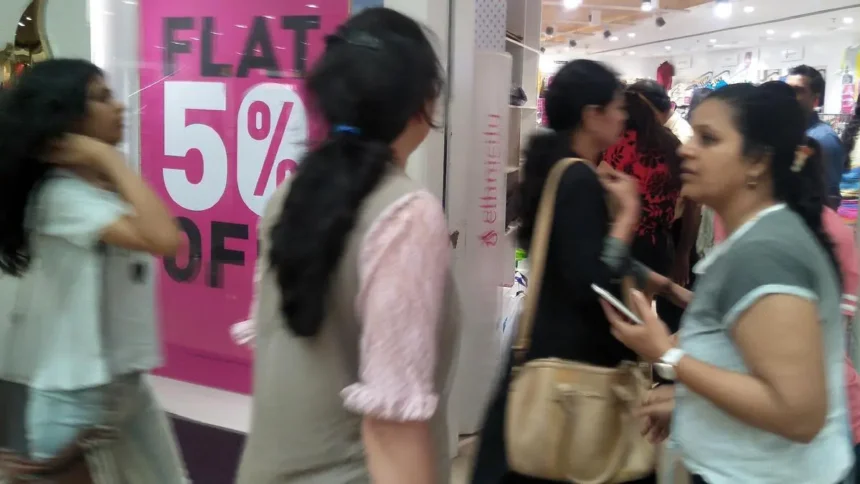
Black Friday, once largely a retail concept borrowed from the West, is finding a place in India’s shopping calendar, emerging as a consumption window between the Deepavali festive rush and the Christmas shopping season. For organised retailers and mall operators, the four-day sale is increasingly serving a dual purpose: clearing unsold festive inventory and making shelf space for winter collections and new seasonal merchandise.
The timing works particularly well for retailers, as demand shifts from ethnic wear during Deepavali to western wear, winter clothing and accessories towards Christmas.
“Black Friday falls right between Deepavali and Christmas, the two peak seasons in India in terms of overall sales. If retailers have unsold Deepavali merchandise, it is a good opportunity to clear that inventory and make room for new launches, particularly in fashion,” said Jermina Menon, CMO – Retail, Commercial and Services, Bhartiya Urban.
The growing traction is reflected in Bhartiya’s sales performance. Black Friday’s contribution to the mall operator’s overall November sales increased from 15 per cent in 2024 to 20 per cent in 2025, while sales during the four-day event grew 28 per cent year-on-year. Overall mall sales in November 2025 rose 14 per cent. The company expects Black Friday sales to grow 30–35 per cent this year over 2025.
Fashion accounted for 35.6 per cent of sales during the event, followed by food and beverage at 16.4 per cent and bags, shoes, books, gifts and accessories at 10.8 per cent. Electronics, entertainment and hypermarkets made up the remaining contribution.
The category mix also points to a shift towards seasonal and affordable purchases rather than big-ticket shopping. Fashion accessories and beauty products are gaining traction as retailers look to move seasonal merchandise, while electronics demand is concentrated in lower-priced products such as wearables and headphones, rather than large appliances or premium smartphones.
“During Black Friday, we are seeing greater traction in sub-₹10,000 electronics, including wearables, headphones and other tech accessories,” Menon said. She attributed this partly to the growing participation of direct-to-consumer brands and younger shoppers who are more familiar with the Black Friday concept.
Mall operators are also seeing the event evolve beyond a single-day promotional exercise. Nexus Select Malls, which operates 19 malls across 15 cities, said Black Friday was increasingly becoming a longer consumption season.
“What started as a one-day promotion has become a season-long consumption driver. Electronics and beauty once led the weekend, but fashion, fast fashion, jewellery and accessories are now growing faster. Shoppers are spending across the whole mall instead of coming in for one big-ticket purchase,” said Nishank Joshi, Chief Marketing Officer, Nexus Select Malls.
“Orion Malls recorded a 15 per cent year-on-year increase in footfalls during its Black Friday sale. Athleisure, electronics, apparel, food and beverage, and entertainment emerged as its best-performing categories, “said Sunil Munshi, COO – Retail, Brigade Group.
Published on November 23, 2026