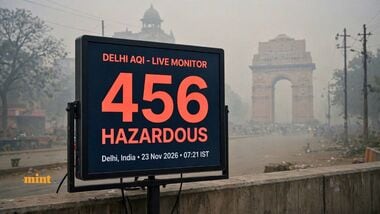
Delhi woke up to hazardous air pollution on Monday, November 23, with the AQI reaching 456. The latest reading highlighted the severe pollution crisis gripping the national capital. According to the live AQI.in monitoring data, the city’s air quality remained firmly in the hazardous category. The reading was recorded at 7:21 AM local time.
The concentration of PM2.5 particles reached 303 micrograms per cubic metre. This was 20.2 times the WHO guideline. Meanwhile, PM10 levels stood at 425 micrograms per cubic metre. This was around 9.4 times the guideline.
The situation appeared particularly concerning because of the extremely high concentration of fine particles. These particles can enter the respiratory system and pose serious health risks. The monitoring platform classified both PM2.5 and PM10 concentrations as unsafe. Delhi also ranked 15th among the world’s most polluted cities at that moment.
levels have fluctuated considerably throughout November. The AQI stood at 306 on November 1 before reaching 461 on November 6. November 9 witnessed an alarming reading of 666, the month’s highest figure. Pollution subsequently declined to 284 on November 15.
However, the improvement proved temporary as pollution increased again during the following days. The reached 406 on November 16 before falling to 224 the next day. Readings subsequently climbed to 353 on November 19 and 341 on November 20. On November 22, AQI was 280 before Monday’s sharp increase.
Other pollutants presented a mixed picture across the national capital. Carbon monoxide levels stood at 1,045 parts per billion. Sulphur dioxide measured four parts per billion while ozone stood at three. Nitrogen dioxide reached 18 parts per billion.
Weather conditions offered little comfort to residents facing the pollution crisis. Delhi recorded a temperature of 16 degrees Celsius with smoky haze. Humidity stood at 59% while wind speed reached 7.6 kilometres per hour.
AQI.in also highlighted the potential health impact of prolonged exposure. It compared Delhi’s pollution exposure to smoking approximately 9.5 cigarettes daily. This estimate assumed continuous exposure to average PM2.5 concentrations over 24 hours. The platform recommended staying indoors, using air purifiers and wearing N95 masks.
was considerably worse than other major Indian metropolitan cities. Mumbai recorded an AQI of 207 while Pune stood at 190. Bengaluru registered 184, Chennai 176 and Ahmedabad 171. Hyderabad recorded 165 while Kolkata reported 102.