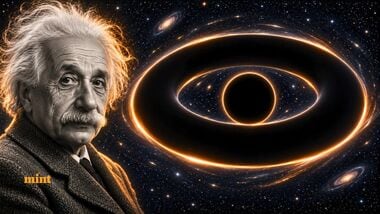
A black hole can take the shape of a ring in five dimensions. A second black hole can sit inside that ring. Physicists call this arrangement Black Saturn. Theoretical physicist Jay Armas has shown how both black holes can spin in two planes. He describes the solution in a preprint on arXiv.
The first mathematical description of Black Saturn appeared in 2007. In that version, both black holes could rotate in only one plane. Armas, who works at the University of Amsterdam, included both possible planes of rotation. These planes are independent, so rotation in one can differ from rotation in the other.
Known spacetime has three spatial dimensions and one temporal dimension. Adding a fourth dimension of space gives ’s equations more possible solutions.
One permits a with a ring-shaped event horizon. An event horizon is the boundary beyond which even light cannot escape.
In Black Saturn, the ring and the spherical central black hole each have separate horizons. The ring needs sufficient spin to prevent its own gravity from collapsing it.
The two black holes also affect the spacetime around each other. As they rotate, they pull nearby spacetime along with them.
Physicists call this effect frame dragging. Armas found that the ring can make the central black hole’s horizon rotate. This can happen in a plane where the central black hole has no intrinsic spin.
The solution also shows that both black holes can reach a state called extremality. This happens when a black hole reaches the maximum spin allowed for its mass.
Its Hawking temperature then reaches absolute zero. At that point, it gives off no Hawking radiation. In five dimensions, reaching this limit with an intact horizon requires rotation in both planes.
In Armas’ solution, both black holes reach this limit together and keep their separate horizons. It is the first known exact solution showing this in otherwise empty five-dimensional spacetime. Both black holes have the same temperature at that point.
Full equilibrium would also require them to rotate at the same rate in both planes. The maths shows that they cannot match those rates while preserving the Black Saturn arrangement.
Black Saturn remains a mathematical possibility. There is no evidence that such a system or its extra spatial dimension exists.
The new solution gives physicists another way to test what ’s theory allows. It could help researchers study how light and matter behave around the two black holes. It could also guide studies of spacetime inside their horizons.