



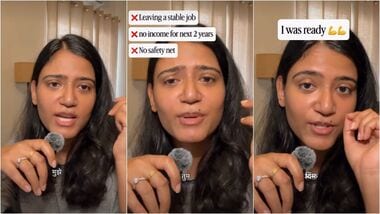
An education loan can remain a financial responsibility for years after a student completes their studies. However, Dimple Porwal, an MBA graduate from the Indian Institute of Management (IIM) , managed to clear her ₹25 lakh education loan in just five years, instead of the 15-year repayment period offered by her bank.
Porwal, who currently works at , recently shared her repayment journey in a video on social media. She explained how planning, regular prepayments and careful use of additional income helped her close the loan a decade earlier than planned. According to her, the approach also helped her save nearly ₹10 lakh in interest.
Her story has attracted attention online, particularly among students and young professionals dealing with .
Porwal pursued her MBA at IIM Kozhikode after leaving a stable job. However, funding the course meant taking on a major financial responsibility.
She recalled that the day her education loan was approved, she could not sleep because she was thinking about the debt she would have to repay.
Being the only child of a single mother made the decision even more challenging. She also had to leave her job, which meant there would be no regular income for the next two years while she completed her .
Instead of waiting until she started earning, Porwal began planning how she would repay the loan even before receiving her first salary at Microsoft.
Her bank had offered a repayment period of 15 years, but she wanted to become debt-free much sooner.
Porwal followed five steps to bring down her loan amount and reduce the interest she would have to pay.
1. Never missed an EMI: Her monthly instalment was around ₹22,000. She made sure every payment was made on time to avoid late fees and protect her credit score.
2. Paid four additional EMIs every year: Apart from her regular monthly payments, she paid four extra EMIs annually. This meant making one additional payment every quarter, helping her reduce the outstanding loan faster.
3. Used bonuses and stock awards: Instead of spending her annual bonuses and Microsoft stock awards, she directed a significant part of this additional income towards loan prepayments.
4. Increased her EMI with salary hikes: Whenever her salary increased by 10%, she increased her monthly loan instalment by the same percentage. This helped her put more money towards the loan as her income grew.
5. Used education loan tax benefits: Porwal also used the tax benefits available on education loan interest and directed the savings towards further repayments.
According to Porwal, she paid approximately ₹4.6 lakh in interest while repaying the ₹25 lakh loan over five years. Had she continued with the original 15-year repayment schedule, the total interest would have been nearly ₹15 lakh.
This means she saved around ₹10 lakh by closing the loan early.
The tax benefit she mentioned is worth understanding. Under the earlier Income-tax Act, Section 80E allowed eligible taxpayers to claim a deduction on interest paid towards qualifying higher education loans. From 1 April 2026, the corresponding provision is Section 129 of the , 2025. Eligibility and conditions apply.
Porwal’s story has received appreciation on , with several users praising her financial discipline and planning. While some congratulated her on becoming debt-free, others said her approach offered useful lessons for people taking education loans.
Her message to those considering a major financial commitment is simple: believe in yourself, but have a repayment plan.
Her experience also highlights how regular prepayments, using additional income wisely and increasing EMIs with salary growth can reduce the overall interest burden.