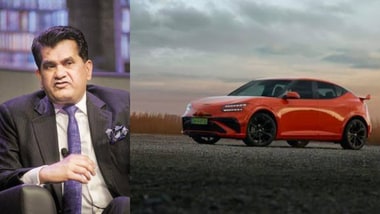
India has overtaken the United States in the share of electric vehicles (EVs) among new car registrations, Former NITI Aayog CEO Amitabh Kant said on Wednesday on X, indicating a significant shift in the country’s electric mobility journey. He highlighted the development, sharing a chart showing India’s battery electric vehicle (BEV) share rising to 8.8% in September 2026, compared with 6.8% in the US.
Taking to X, Kant underscored India’s accelerating electric mobility transition, but said the next phase of growth would depend on building a stronger charging infrastructure.
“India has overtaken the in EV adoption! From just 0.03% EV market share in 2019 to 8.8% in September 2026, India’s electric mobility story is accelerating fast,” he wrote.
Despite the improvement in adoption, Kant cautioned that higher vehicle sales alone would not be enough to sustain India’s electric mobility transition.
He mentioned that expanding charging infrastructure would be essential to encourage more people to switch from conventional petrol and diesel vehicles to electric alternatives.
His recommendations include setting up more fast-charging facilities along highways, ensuring dependable charging points in residential complexes and expanding public charging access in Tier 2 and Tier 3 cities.
“But the next leap won’t come from EV sales alone. India must build a robust charging network: more fast chargers along highways, reliable charging in residential complexes, and accessible public charging stations in Tier 2 and Tier 3 cities,” Kant added.
The chart shared by compares the battery electric vehicle share of new car registrations in India and the United States between 2019 and September 2026.
According to the figures, India’s BEV share stood at just 0.03% in 2019, before increasing to 0.42% in 2021 and 2.2% in 2023. The share climbed further to 4.3% in 2025 before reaching 8.8% in September 2026.
The US, meanwhile, had a higher BEV share in the initial years, standing at 1.4% in 2019 and 3.1% in 2021. Its share rose to 5.5% in 2022 and peaked at 7.8% in 2024 before declining to 7.5% in 2025 and 6.8% in September 2026.
The comparison suggests that India’s electric car market has gained considerable momentum in recent years, narrowing and eventually reversing the gap with the US in the share of new vehicle registrations.
The graphic cites VAHAN, FADA and the Government of India as sources for Indian figures, while US figures are attributed to Argonne National Laboratory and Wards.
It also specifies that figures for 2019-2025 represent annual shares, whereas September 2026 figures are monthly shares.
The government plans to extend the Unified Bharat e-Charge platform to more states in phases as its charging network becomes more reliable, Hanif Qureshi, Additional Secretary in the Ministry of Heavy Industries, said on Friday, according to ANI.
Around 12 charging network operators have joined the platform, which enables electric vehicle owners to locate charging stations, access their services and make payments across participating networks through a single interface.
“We have made it available for pilot testing in five states. As the network becomes more robust, we will keep expanding it,” Qureshi told reporters on the sidelines of the inaugural Growth and Readiness for EV Infrastructure Dialogue (GRID). The event was organised by the Society of Indian Automobile Manufacturers (SIAM) as part of its National EV Charging Day programme.
Qureshi said the platform was jointly developed by NPCI BHIM Services Ltd and Bharat Heavy Electricals Ltd. He added that most manufacturers of electric two-wheelers, three-wheelers and four-wheelers had also been onboarded.
However, he did not specify a timeline for expanding the pilot to additional states.