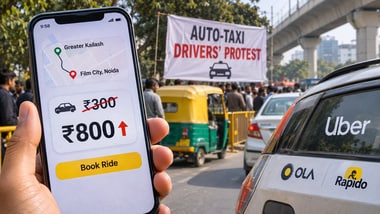
across surged on Thursday morning as transport unions staged a protest demanding higher auto and taxi fares, among other changes. The disruption during peak office hours left commuters paying significantly more for their daily journeys.
A cab ride from in South Delhi to Film City in Noida, which typically costs around ₹300 on ride-hailing platforms such as Ola and Rapido, was showing fares exceeding ₹400 at around 9 am. By approximately 10 am, as office-hour demand peaked, the fare had crossed ₹500.
One passenger even ended up paying ₹800 for the same journey, reported India Today.
The protest, organised by transport unions affiliated with the Bharatiya Mazdoor Sangh (BMS) at Delhi’s Ramlila Maidan, centred on demands for a revision of auto and taxi fares, a ban on private bike-taxi services, and the withdrawal of certain fitness-related requirements for auto-rickshaws. Drivers have also raised concerns over their livelihoods, working conditions and personal safety.
A Delhi-based cab driver, who was driving on the day of the protest, told India Today, “If the government can ban TikTok, why can’t it ban Ola, Uber and Rapido?”
The driver argued that Bharat Taxi was a better alternative but questioned why the platform had failed to gain traction among commuters. He suggested that banning other cab-hailing applications would help the alternative gain popularity. Interestingly, he is registered on all four cab-hailing platforms.
The impact of the protest was also visible in the fares commuters were paying for shorter journeys.
A South Delhi-based homemaker told India Today Digital that an approximately 3-km auto ride to Cambridge School from Hemkunt Colony was showing a fare of ₹90-92 on Uber, compared with the usual ₹75-80.
“The hourly rental fare for a cab, which generally costs ₹325 for a one-hour booking with a 10-km limit, had climbed to ₹406,” she told India Today.
She added that regular cab fares were also around ₹10-15 higher than usual.
The homemaker subsequently booked a round trip from Greater Kailash to Sreenivaspuri on Uber. However, the driver refused to accept the app-displayed fare of ₹190 for both ways and instead demanded ₹150 for a one-way journey, taking the total to ₹300.
She also highlighted the inconvenience caused by drivers refusing to honour fares displayed on cab-hailing applications and demanding higher payments from passengers.
A review by India Today Digital found that fares on Ola and Rapido had increased by at least 30% during non-peak hours for both auto-rickshaw and cab rides.
For drivers, however, the concerns extend beyond fluctuating fares during peak hours. Anupam Kumar, a cab driver operating on both Ola and Rapido, said the payment structure on ride-hailing platforms makes longer journeys increasingly unviable.
According to Kumar, drivers generally receive a fixed payment of around ₹104-114 for the first 3 km, depending on the cab-hailing application. While this amount may appear reasonable for shorter trips, the payment per kilometre declines as the distance increases.
He explained that the payment structure is divided into distance-based brackets. While the first 10 km offers relatively better returns, the payment drops considerably in the 10-20 km bracket and falls further for journeys between 20 and 30 km.
“Say we take a ride from South Delhi to Gurgaon or Greater Noida, which is around 30–35 km. The amount we earn keeps getting reduced in every 10-km bracket. By the time we reach the 20–30 km stretch, there is barely any money left to make when the fuel cost is the same for every bracket,” Kumar said.
He added that the issue was not limited to one platform but was common across several cab-hailing applications.
Kumar also highlighted differences in how ride-hailing platforms compensate drivers for waiting time in traffic.
“While Ola increases the fare depending on the time spent waiting, he said, Rapido does not offer the same benefit, with the amount remaining unchanged regardless of how long a driver is stuck in traffic,” Kumar told India Today Digital.
The protest has also had implications beyond the national capital. Kumar said transport unions in areas such as Ambala and Chandigarh, along with parts of Haryana outside Gurugram, had been particularly strict in enforcing the strike.
According to him, union members are checking vehicles arriving from Delhi-NCR to establish whether they are operating through app-based bookings or traditional offline arrangements.
Drivers found using cab-hailing applications to ferry passengers are allegedly having their phones seized, he said.
The action has made it difficult for drivers to continue accepting app-based bookings in certain areas beyond Delhi-NCR.
Apart from fare revisions and declining earnings, cab drivers have also raised concerns about their personal safety.
Kumar said incidents of violence against cab drivers, including a recent murder in Faridabad, have heightened anxiety among those working in the sector.
The issue has gained significance amid several reported cases of fatal violence involving taxi and cab drivers in the Delhi-NCR region in 2026.
Drivers are seeking stronger safeguards, including a customer identification system that would allow them to verify passengers before accepting rides.
The unions organising Thursday’s demonstration have also demanded a dedicated welfare board for auto and taxi drivers, a review of Delhi’s electric vehicle policy to address transport workers’ concerns, and faster processing of work-related documentation at the Delhi Transport Department.