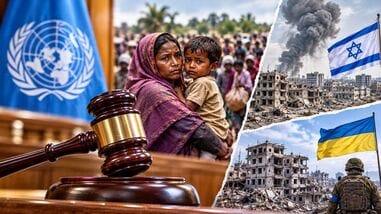
The International Court of Justice (), the United Nations’ top court, on Thursday ruled that Myanmar had committed genocide against the Rohingya, a long-persecuted minority. The landmark verdict was one that survivors of the atrocities had awaited for nearly a decade.
According to CNN, the ruling marks the first time in its 80-year history that the ICJ, also known as the World Court, has found a state responsible for committing genocide.
The judgment could also carry implications for other conflicts in which allegations under the Genocide Convention have been brought before the World Court, particularly the ongoing proceedings involving Israel over its military campaign in Gaza and over its actions in Ukraine. While the legal questions in these cases differ, the Myanmar verdict could offer insights into how the ICJ assesses evidence, establishes genocidal intent, and determines a state’s responsibility under the convention.
Between 2016 and 2017, Myanmar’s military carried out operations in areas inhabited by the Rohingya, a minority community in the Buddhist-majority country. The crackdown involved widespread violence, including killings, looting and the burning of homes and villages, forcing hundreds of thousands of Rohingya to flee to neighbouring .
Reports at the time documented harrowing accounts of members of the community being raped or killed by soldiers. In some instances, Buddhist neighbours were also reported to have joined the attacks. Images from the period showed people fleeing burning villages on foot or crowding into boats as they attempted to reach Bangladesh.
In November 2019, The Gambia, a country thousands of miles away from Myanmar, instituted proceedings against it at the ICJ, accusing it of violating the Genocide Convention.
After examining evidence and hearing witness testimony over several years, the ICJ, in a 9-6 decision, concluded that the scale and nature of Myanmar’s atrocities were “characteristic of an intent to destroy a substantial part of the group,” presiding judge Iwasawa Yuji said while delivering the nearly three-hour judgment.
The court further stated: “The court is of the view that the only reasonable inference that can explain Myanmar’s actions is an intention to destroy” the Rohingya population in northern Rakhine State.
In its judgment, the ICJ also found that Myanmar’s military had engaged in indiscriminate killings. It took into account “widespread acts of sexual violence, and extreme acts of violence against children”, as well as attacks by security forces on “Rohingya as they sought to flee in large numbers to Bangladesh”.
The court ordered Myanmar to provide reparations to the Rohingya. These include facilitating their safe, voluntary and dignified return, reuniting displaced families, and restoring or replacing property that was lost or damaged. It also addressed measures relating to missing persons, the recovery and dignified burial of bodies, and rehabilitation for survivors. Where restitution is not possible, compensation may be awarded, with the amount and terms to be determined in a subsequent phase of the proceedings.
However, while judgments are final and binding on the countries involved, the court has no independent enforcement mechanism. Under Article 94 of the UN Charter, if a country fails to comply with a judgment, the other party may approach the UN Security Council, which can make recommendations or decide on measures to give effect to the ruling. Such a referral is not automatic.
The Myanmar judgment could be relevant to the ongoing case against , which South Africa brought before the ICJ in December 2023, two months after ‘s October 7 attack on Israel triggered the war in Gaza. South Africa accused Israel of violating the 1948 Genocide Convention through its military operations in the Palestinian territory. Israel has rejected the allegations.
In an order dated January 26, 2024, the ICJ directed Israel to take provisional measures, including steps to prevent acts prohibited under the Genocide Convention, preserve evidence and facilitate humanitarian assistance. The court subsequently issued additional provisional measures as the situation in Gaza developed.
The Myanmar judgment could provide a point of reference for the court when considering evidence and the question of genocidal intent. However, it does not determine the outcome of the case against Israel, which will be assessed on its own facts and legal arguments. The proceedings remain pending. According to the ICJ’s latest case updates, South Africa’s next written submission is due in November 2027, followed by Israel’s submission in May 2029.
The proceedings also involve the Genocide Convention, but the legal dispute is different. In February 2022, Ukraine approached the ICJ after Moscow claimed that genocide was being committed in the Donetsk and Luhansk regions of eastern Ukraine and cited those allegations as part of its justification for launching its military operation.
Kyiv challenged Russia’s claims, arguing that there was no credible basis for the genocide allegations and that the convention could not be invoked to justify military action against Ukraine.
The case, titled “Allegations of Genocide under the Convention on the Prevention and Punishment of the Crime of Genocide (Ukraine v. Russian Federation)”, remains pending. In December 2025, the ICJ declared Russia’s counterclaims against Ukraine admissible, allowing that aspect of the dispute to proceed. In a further order dated November 6, 2026, the court extended the deadlines for written submissions. Ukraine’s reply is now due by March 8, 2027, while Russia’s rejoinder is due by June 8, 2028.
The Myanmar verdict does not automatically settle either of these cases. ICJ judgments are binding on the parties to the particular dispute and do not operate as binding precedents in other proceedings. Nevertheless, the court’s reasoning on how genocidal intent is established and how evidence is assessed could be closely examined in future cases involving allegations under the Convention.