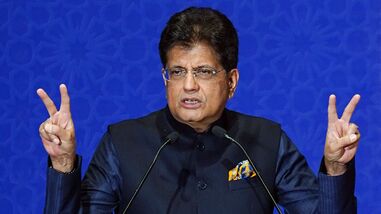
New Delhi: India and the US are “natural partners who build a chain of trust” in a volatile global environment, and their strong ties are reflected in their engagement at every level, commerce and industry minister said on Thursday, as both sides work towards finalising a proposed trade deal.
Addressing the Indo-American Chamber of Commerce’s summit, themed “One Shared Future” in the national capital, Goyal said, “At these uncertain times, the world no longer needs just supply chains. They need trusted supply chains–the partner that shares your vision, respects the rule of law, honours contracts. And, therefore, India and the US are natural partners who build a chain of trust, a trusted chain.”
The US–the world’s largest economy–offers capital, technology and innovation. India has talent, manufacturing strength and competitiveness, he said. “So, both are a force for global good, and an engine for global growth. That truly sums up the US-India friendship, the US-India partnership.”
Speaking at the last week, external affairs minister S. Jaishankar had said India and the US were in the last stretch of clinching the .
“We really have the bulk of the issues sorted out. There are the last stretch of issues. And in many cases, these concerns are not so much at our end, because the changes have been more at the American end than ours. So, the hope is that we should close it out soon,” Jaishankar had said.
Both Goyal and Jaishankar have said that India wants a mutually beneficial trade deal that will give New Delhi a comparative advantage over its competitors in the US market.
On 15 November, Goyal said in Cairo that India and the US have already agreed that Indian goods in the American market will receive preferential market access compared to competitor nations, news agency PTI had reported.
Earlier this month, the US reaffirmed its commitment to ties with India, seeking to allay concerns that the Republicans’ midterm election defeat could derail trade talks with New Delhi. The American embassy spokesperson in New Delhi told Mint on 4 November that president Donald Trump “remains firmly in command” of US foreign policy, including the trade agenda.
“The midterm election results do not change our commitment to strengthening our partnership [with India],” the spokesperson had said. The comments were in response to Mint’s query on whether Democratic control of Congress would in any way impact the ongoing trade deal negotiations.
Experts in India have seen both challenges and opportunities in the electoral loss suffered by Trump’s Republican Party. While a Democrat-controlled Congress could make ratification of a trade deal harder to accomplish, Trump’s political setback may also give New Delhi greater leverage at the negotiating table.
The US is India’s biggest export market, accounting for goods supplies worth $87 billion last fiscal. This represented nearly a fifth of India’s total merchandise exports in FY26.
Indian exports to the US currently face an uneven tariff regime. About 55% of shipments, including engineering goods, textiles and garments, and gems and jewellery, attract the usual most-favoured-nation (MFN) duties, along with a punitive tariff of 10% imposed over the alleged use of forced labour in exported goods. In textiles and garments, US MFN duties can go up to 32%. For most gems and jewellery, they range between 5.5% and 6%.
Another 35-40% of goods, including smartphones, pharmaceuticals and certain farm products, are exempt from the levy. Steel and aluminium exports, however, face a much higher tariff of 50%.
For Indian exporters, the deal may offer greater certainty on US tariff policy, allowing them to price contracts with more confidence, experts have said. Any increase in exports would also provide timely support to an economy grappling with the fallout from the war in West Asia.
In return, India may lower tariffs on a select list of American farm products and increase purchases of US crude oil and liquefied natural gas. The proposed agreement also aims to deepen cooperation in defence technology and critical minerals, experts have said.
In his speech at Indo-American Chamber of Commerce, Goyal said that during his discussions with his Egyptian counterpart and the Egyptian Prime Minister this week, both sides had agreed to let officials work towards finalising the terms of reference for a preferential trade agreement, or a free trade agreement.
He also said once the India-EU comes into effect in the first quarter or first half of calendar year 2027, bilateral trade with Italy has the potential to grow to 20 billion euros in the next 3-4 years and to 50 billion euros a few years after that, from the current 14 billion euros.