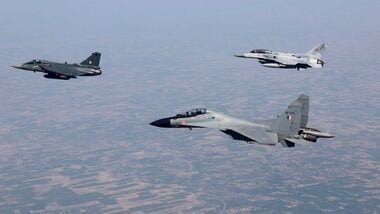
India’s defence manufacturing capabilities have come under intense scrutiny, with Hindustan Aeronautics Limited (HAL) facing mounting criticism for persistent delays in delivering the Light Combat Aircraft (LCA) Tejas Mark 1A.
According to a recent report by NEWS9 Live, the issue gained significant traction following sharp criticism from a former Indian Air Force (IAF) chief regarding the sluggish pace of aircraft integration and handover.
The Tejas Mark 1A is a crucial pillar of the IAF’s modernisation strategy, specifically designed to plug the capability gap left by the retirement of ageing squadrons.
The original plan envisioned a seamless transition: as the MiGs were phased out, new Tejas squadrons would immediately take their place.
However, according to NEWS9 Live, the severe delivery delays mean that the MiG-21s are retiring much faster than the new LCAs are arriving, triggering alarm over a dangerously depleting number of active fighter squadrons.
While government officials have acknowledged systemic problems within India’s defence manufacturing apparatus, they point out that the delays are not solely the fault of domestic assembly lines, NEWS9 Live noted.
A major culprit is the heavy reliance on external supply chains for critical aerospace components, the publication said,
The most glaring bottleneck is the aircraft’s powerplant — The Tejas relies on the GE F404 engine imported from the United States, which the NEWS9 Live report described as the “heart of this entire aircraft”.
Deliveries of these contracted engines have been repeatedly delayed, NEWS 9 Live reported. To mitigate this, HAL devised a stopgap strategy to manufacture the aircraft frames and keep them ready on the tarmac, planning to integrate the engines later upon arrival.
Unfortunately, this strategy has largely failed because several other critical imported parts are also facing severe supply chain disruptions.
Beyond external shocks, a senior defence official acknowledged that some fault lies within the defence Public Sector Undertakings () themselves. The government is currently scrutinising HAL’s internal ability to manage its own production systems and assembly lines effectively.
To address this dual-front crisis, the government has initiated strict corrective measures.
According to NEWS9 Live, defence PSUs have been directed to conduct a comprehensive review of their supply chains within three months of receiving any order for a defence platform.
This exercise is designed to identify vulnerabilities and secure alternative sourcing to prevent single-component shortages from derailing entire projects.
Furthermore, the government is strictly linking performance evaluations to project deadlines to drive accountability. Starting this year, timely delivery will carry a weightage of 10 marks in the performance assessments of all defence PSUs.
As the NEWS9 Live report highlighted, the Tejas delays underscore a harsh reality for India’s defence industry: while the nation has brilliantly demonstrated the ability to develop cutting-edge aviation technology, establishing the reliable, industrial-scale supply chains needed to mass-produce it remains a formidable hurdle.