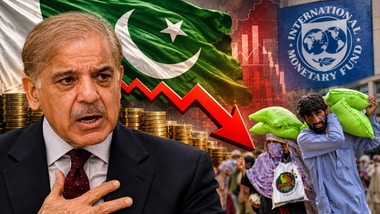
Pakistan Prime Minister Shehbaz Sharif has expressed confidence that the country could become the world’s sixth-largest economy before 2050, bringing forward by more than 25 years a timeline projected by Goldman Sachs.
However, the ambitious target comes against the backdrop of mounting government debt, repeated dependence on international financial assistance, sluggish economic growth and rising poverty.
Speaking at the Pakistan Minerals Investment Forum 2026 in Islamabad on November 13, Sharif referred to a assessment that projected Pakistan could become the world’s sixth-largest economy by 2075.
“I would like to make a small amendment here. Instead of 2075, it will be, Inshallah, earlier than 2050,” he said.
However, the prime minister’s ambitious projection faces a considerable economic challenge.
Pakistan continues to grapple with a large debt burden, limited fiscal room and structural weaknesses that have constrained its ability to generate sustained economic growth.
Pakistan’s total debt and liabilities climbed to ₹98.881 trillion at the end of September 2026, marking a 6.46% increase from ₹92.879 trillion a year earlier, according to data released by the State Bank of Pakistan.
The country’s total debt stood at ₹97.038 trillion, including government domestic debt of ₹57.758 trillion and external debt of ₹37.197 trillion.
The pressure is also visible in Pakistan’s external repayments. The country’s external public debt stood at $98.075 billion as of June 30, 2026, according to the Ministry of Economic Affairs.
paid $14.436 billion towards servicing its external public debt during FY26, including $11.198 billion in principal repayments and $3.238 billion in interest payments.
The growing debt burden leaves the government with limited resources to invest in infrastructure, education, healthcare and other areas critical to long-term economic development.
Pakistan’s reliance on international remains another challenge to its long-term economic ambitions.
In October, the International Monetary Fund () reached a staff-level agreement with Islamabad on the fourth review of its $7 billion Extended Fund Facility and the third review of its $1.4 billion Resilience and Sustainability Facility.
The agreement could unlock approximately $1.2 billion in additional funding, subject to approval by the Executive Board. The latest disbursement would bring total funding under the two programmes to around $5.7 billion.
While Pakistan has made progress towards macroeconomic stabilisation, the IMF has continued to flag the need for fiscal discipline, debt management and structural reforms.
The World Bank has also highlighted persistent weaknesses in the country’s economic recovery.
Pakistan’s real grew 3.7% in FY26, up from 3.2% in FY25, but growth remains insufficient to generate enough jobs for its expanding workforce.
According to the World Bank, around 3.5 million people enter Pakistan’s workforce every year, while job creation has failed to keep pace with the growing number of job seekers.
The country’s national poverty rate also increased from 22% in FY19 to 29% in FY25, leaving approximately 70 million people living in poverty, the World Bank estimated.
The assessment cited by Sharif was published in December 2022 under the title ‘The Path to 2075: Slower Global Growth, But Convergence Remains Intact’.
The report projected that could become the world’s sixth-largest economy by 2075, provided it implemented appropriate policies and strengthened its institutions.
The projection also took demographic trends, productivity improvements and economic convergence into account.
A growing population could expand Pakistan’s economic potential, but translating that demographic advantage into higher incomes and productivity would require sustained structural reforms.
Importantly, the 2050 timeline mentioned by was his own optimistic and not a realistic revision of the Goldman Sachs projection
With inputs from agencies.