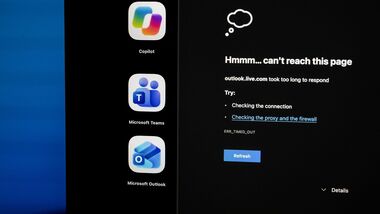
A worldwide outage of Microsoft’s Outlook email service disrupted businesses, financial institutions and shipping companies on Friday, forcing millions of users to rely on traditional communication methods such as telephone calls, fax machines and Bluetooth to continue their operations.
The prolonged disruption also affected Teams and Copilot, slowing down trading, administrative work and business communications across several countries.
The outage hit some of the world’s largest institutions, including banks, stock market operators, insurers and shipping companies. Although most organisations reported that their core systems remained operational, the disruption exposed their dependence on a handful of technology providers for everyday business activities.
blamed server-related problems for the outage and said it had found no evidence of malicious activity.
Microsoft, which says more than 430 million people use its Microsoft 365 services, acknowledged the disruption and said it was working to restore normal operations.
In its latest update on Friday, the Redmond, Washington-based technology company reported broader improvements in North America and sustained progress across much of Europe.
It also reported encouraging recovery signals in the Asia-Pacific region.
“We’re seeing encouraging recovery progress, with service availability and email delivery performance improving across a growing portion of affected Microsoft 365 infrastructure,” the company said, as some users started reporting that their emails were restored.
The exact number of users affected by the outage remains unclear. However, Microsoft said in January that it had more than 450 million paid commercial Microsoft 365 subscriptions.
“Some users may still experience intermittent access issues or delayed email delivery as recovery continues,” it said in its latest post.
The disruption has once again highlighted the risks associated with the concentration of critical business services among a small number of technology providers.
The outage forced several major organisations to activate alternative communication arrangements.
European exchange operator Euronext, which operates stock exchanges in Paris, Brussels, Lisbon, Amsterdam, Oslo, Athens and Milan, advised listed companies to communicate through telephone calls.
“We have ensured that the team has sufficient capacity to manage the situation and handle the additional workload,” a spokesperson said, adding that Euronext was verifying the identity of callers to protect confidentiality and integrity.
Shipping giant Maersk also asked customers to use phone calls for urgent matters. The company advised them to verify unexpected communications relating to the outage with their local representatives.
The disruption highlighted how businesses can struggle to maintain routine operations when email services become unavailable, even when their core technology infrastructure continues functioning.
British insurance company Aviva, which reported its earnings on Friday, activated backup arrangements to manage the disruption.
The insurer circulated alternative telephone numbers for earnings calls and used Bluetooth technology to transfer recordings because email services were unavailable.
Aviva CEO Amanda Blanc told Reuters that the company had conducted a test of a similar-scale outage involving its most critical technology systems around two weeks earlier.
The preparations helped the insurer activate alternative communication arrangements during Friday’s disruption.
Financial institutions in Taiwan were among those affected by the Microsoft outage.
The disruption reportedly affected fund management operations at securities firms, life insurance companies and investment trust businesses, according to people familiar with the situation.
At one financial institution, transactions involving the purchase and sale of short-term bills, which are normally confirmed through email, had to be processed using fax machines instead.
Foreign banks and financial institutions in Taiwan were particularly affected because much of their data is routinely sent to overseas headquarters through Microsoft’s systems, Reuters reported.
In Britain, HSBC and Barclays activated internal incident response teams to assess the impact of the outage, according to people familiar with the matter.
Although their email systems were affected, most customer-facing services continued operating.
HSBC also reminded employees not to use unauthorised communication channels, including personal email accounts and WhatsApp, to bypass the disruption.
Meanwhile, two trading professionals told Reuters that they had observed lower trading volumes in certain markets on Friday, attributing the decline partly to difficulties in executing transactions.
The global disruption has renewed concerns about the vulnerability of businesses that depend heavily on a limited number of technology providers.
The incident comes weeks after attacks targeting industrial systems responsible for keeping supermarket food supplies refrigerated.
Even when core business systems remain operational, the inability to access email and collaboration platforms can slow down financial transactions, administrative processes and communication across international operations.