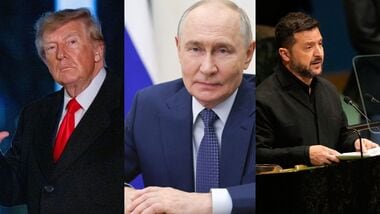
US President Donald Trump’s push to end Russia’s war against Ukraine is increasingly extending beyond a ceasefire, with Washington exploring a broader security arrangement involving Moscow and European nations.
The proposed framework could address some of Russia’s long-standing demands, including limits on NATO’s expansion and its military presence in Eastern Europe, raising questions about the future of European security and the alliance’s role.
According to sources cited by Axios, the administration is now open to discussing security concerns that Moscow has repeatedly raised over the years.
These issues were also central to Russia’s draft security proposals submitted to the US and in 2021, which called for restrictions on the alliance’s eastward expansion and a rollback of parts of its military presence in Eastern Europe.
The renewed discussions have raised concerns over whether Washington’s efforts to negotiate an end to the war could give Russian President Vladimir greater influence over Europe’s security arrangements.
The US proposal reportedly seeks to address two interconnected aspects of the conflict: ending the fighting in Ukraine and establishing a wider security framework between Russia and Europe.
Two sources cited by Axios said Washington wants Moscow to put forward proposals that take into account Russia’s security concerns while also offering assurances that would help European countries feel confident about their future security.
The objective, according to the report, is to develop an arrangement that addresses Moscow’s concerns without leaving European nations vulnerable to another potential Russian attack.
The request was raised during two days of US-sponsored negotiations between Russian and Ukrainian delegations in on November 10 and 11.
Russia has consistently opposed NATO’s eastward expansion, arguing that the alliance’s growing presence near its borders threatens its security.
In December 2021, presented draft security agreements to Washington and NATO, demanding guarantees against further enlargement and restrictions on the deployment of military forces and weapons in Eastern Europe.
These demands became a major point of contention in the months leading up to Russia’s full-scale invasion of Ukraine in February 2022.
The latest US diplomatic initiative appears to bring some of these long-standing Russian concerns back to the negotiating table.
However, any discussion of limiting NATO’s military presence or future expansion could create tensions with allies, particularly countries in Eastern Europe that view the alliance as a critical security guarantee against Russian aggression.
According to The Washington Post, the proposed framework draws on the now-defunct NATO-Russia Council, which previously provided a platform for dialogue between Moscow and the military alliance.
Such an arrangement could give Russia a formal channel to raise its security concerns and engage with European countries on wider security issues.
However, the proposal could prove controversial. European officials are concerned that giving Moscow a greater role in discussions about the continent’s security could allow the Kremlin to influence decisions that traditionally fall within the sovereign rights of individual and NATO members.
The central question is whether a broader security arrangement can address Russia’s concerns without compromising NATO’s independence or the security interests of its European members.
Trump’s special envoys, Jared Kushner and Steve , are expected to meet Putin in Moscow on November 12 to discuss the proposed framework and assess progress made during the Abu Dhabi negotiations.
According to Axios, Washington is also looking at involving European representatives in future rounds of discussions.
The US envoys are subsequently expected to travel to Dublin to meet Ukrainian President Volodymyr , who is in Ireland for discussions with European leaders.
The latest diplomatic effort follows the first US-mediated direct negotiations between Russian and Ukrainian officials since February.
Kushner described the discussions as difficult but productive, indicating that Washington wants Moscow to offer more than a list of demands.
“We told the Russians, they have their desires and fears, but they have to provide different de-escalation and different proposals as well, if they want Europe to be able to receive those proposals in a good way,” he said.
Trump has repeatedly expressed optimism about reaching an agreement to end the war.
Earlier, he said he had met Putin’s envoy at the White House and suggested that a “big, beautiful agreement” could be within reach.
His optimism was echoed by , who said US officials had held productive and substantive discussions with Ukrainian and representatives in Brussels on November 5.
However, negotiating an end to the war remains complicated by the competing security demands of Russia, Ukraine and European nations.
While Moscow wants restrictions on NATO’s military reach, Ukraine and its European partners are seeking lasting security guarantees to prevent another Russian offensive.