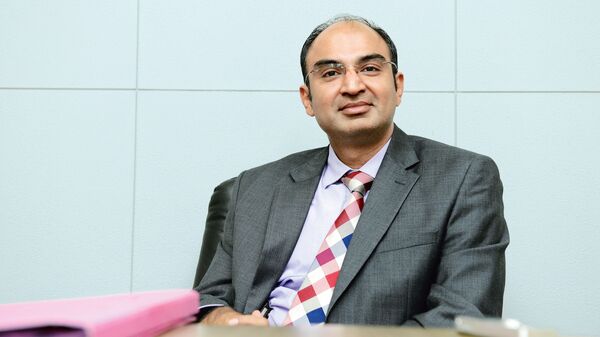
Artificial intelligence agents could soon handle up to 40% of Cognizant Technology Solutions Corp’s client work, and whether its human workforce increases or decreases will depend on how fast the company grows.
That was Cognizant’s chief financial officer, Jatin Dalal, in a fireside chat with BMO Capital Markets’ Keith Bachman on Thursday as the Nasdaq-listed company battles peers to retain and win clients amid uncertain demand and fears of AI-led deflation.
Dalal said 70% of a client’s work needs exact answers, while 30% depends on judgement and likely outcomes. The company is looking at selling both human and agentic workforces to clients.
“So, if we are providing that, we will naturally have 30, 40% of work being provided by virtual agents, which is inference and tokens, and 70% of that work is being provided by humans,” said Dalal.
Hiring, he said, now hinges on growth.
“If you believe we will grow only 15% in five years in aggregate, in that case, that human workforce will shrink. There is no choice around that,” said Dalal, adding that more humans may be required if the company is 1.5 times its current size.
That matters most in India, where almost three-fourths of Cognizant’s 351,600 employees work.
To be sure, the company did not give a timeline by when its work would be handled by AI but responded to a question on the company’s employee strength in three years.
Infosys Ltd chief executive officer Salil Parekh said at a Bloomberg event last month that AI services could be 20-30% of the company’s work in a few quarters and “almost half” in two or three years. He was referring to AI-related projects as a share of the business, not to the share of work done by AI agents.
The fight for limited growth has also affected prices. Dalal said 2026 was probably the most intense year on pricing in over the past three years.
“And that is probably because the industry saw very little – at least in the first half, the impact of AI was very meaningful, and therefore the growth was scarce, and therefore firms were competing to retain share or or gain share, and that’s the phase we are in. We’ll have to wait and watch what happens in 2027,” said Dalal, who expects revenue deflation to ease in the second half of next year.
Cognizant, which follows a January-December financial year, ended 2025 with $21.1 billion in revenue, up 7%. Last month, it cut its guidance to 4.5-4.9% growth for this year and flagged slower tech spending by healthcare and consumer clients.
Dalal saw it coming. In September last year, he was the first to share AI’s impact on the sector, saying clients that generally sought up to 20% discounts on renewals were asking for about 25%. His answer is to sell more than just labour: managing AI agents and models.
“[W]e are channelizing inference to create an outcome for our customers. So, it would be a great thing for industry if the inference starts flowing from IT,” said Dalal, on changes in third-party resale.
AI inference is when a trained artificial intelligence or machine learning model applies its learned patterns to new, unseen data to make predictions, classifications, decisions or generate content.
“There are four components which go into what we call as integrated offerings. One is infrastructure, second is SaaS (software-as-a-service), third is security software and fourth is inference. And the reason we are now trying to bundle and deliver is we want to go towards getting to an outcome-based contract,” he said.
Dalal joined Cognizant as CFO in December 2023 after more than two decades at Wipro Ltd, most recently as its CFO.
Almost three-fifths of the Teaneck, New Jersey-based company’s revenue already comes from fixed-price contracts, and Dalal expects that share to rise. In March, he said Cognizant tracks its bids and bets to design better responses, with CEO Ravi Kumar and him reviewing deliverables monthly.
Dalal played down any existential threat, saying clients prefer IT services firms over the consulting arms of AI companies.
“Almost every large software company has a consulting arm, which they use for the sort of very difficult case studies. But rest of the mass value generation takes place to third parties because we are seen as an advocate of the customer whose focus is to minimize cost, and therefore token consumption, and maximize the value for the customer. Whereas, if I am an implementer for an LLM provider, my interest would be to maximize the token for my parent company,” said Dalal.
But AI savings may not be passed on to clients as easily as past productivity gains. Today, staff not needed on a project can be reassigned and a client’s costs can be reduced within 90-180 days, with no leftover costs.
“I may have bought something, a customer bought something with a commitment to an LLM provider for three months, three years, four years, five years. So that setup cost is going to be higher, committed cost is going to be higher, and therefore that risk-reward model has to be different. But it will evolve as we go,” said Dalal.
For now, he expects AI inferencing to be the future of the IT industry.
“It would be good because then, as a service provider, we are undertaking human effort and virtual effort and delivering an outcome for customers. So, if you really ask me, that’s the future I see of the industry, and that is what we are working towards,” said Dalal.