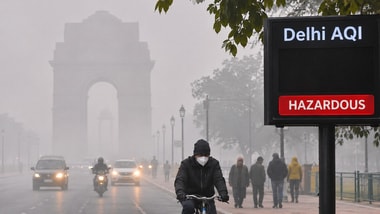
Delhi’s air quality deteriorated to hazardous levels on Friday morning, with the national capital’s overall Air Quality Index (AQI) reaching 403 at 8.40 am, according to data from Central Pollution Control Board (CPCB).
According to a report by news agency ANI, the average of the capital was 494 at 7.31 am.
Dense fog and pollution engulfed several parts of the city, reducing visibility, while multiple monitoring stations recorded severe pollution levels.
According to , IIT Delhi was among the worst-affected locations, recording an AQI of 488. ITO followed with an AQI of 455, JNU 451 while Anand Vihar recorded 419, Rohini 413 and Rajokri Border 402. All fell in the severe category.
Other parts of the national capital also reported very poor air quality. In all over 33 stations in the capital recorded over 400, severe category.
Amid worsening air quality, the Delhi government has deployed water sprinklers across the city.
Meanwhile, Aam Aadmi Party (AAP) leader Saurabh Bharadwaj on Thursday criticised the BJP-led and questioned the credibility of the CPCB’s AQI data.
Citing a report by the Centre for Research on Energy and Clean Air (CREA), Bharadwaj alleged that pollution levels displayed on government websites were 49% lower than the actual figures. He described the alleged discrepancy as a fraud against Delhi’s population.
Speaking to ANI, Bharadwaj claimed that an AQI reading of 370 could have been closer to 560 or higher based on the findings he cited.
He also questioned the CPCB’s treatment of readings above 999, claiming that the agency did not display values beyond that threshold because its measurement system could not record higher levels.
The Centre for Research on Energy and Clean Air (CREA), in its analysis of hourly PM2.5 data from 59 monitoring stations across Delhi, found 255 missing hourly station records between 4 pm on November 8 and 4 pm on November 9, according to ANI.
The analysis also recorded a rise in the 24-hour average PM2.5 concentration from 269 to 400 micrograms per cubic metre, an increase of nearly 49%.
Bharadwaj cited these findings to allege discrepancies between the pollution levels recorded and those displayed on official government platforms.