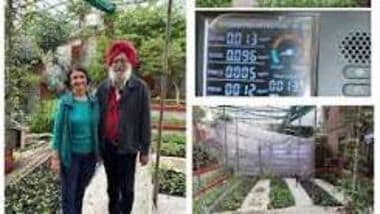
As Delhi continues to battle toxic air, one home in the national capital is drawing attention for maintaining an indoor Air Quality Index (AQI) of around 10-15. The residents, Peter Singh and Neeno Kaur, have created a green living space with approximately 15,000 plants, filtered air and an aquaponics-based farming system.
The couple’s home has come into focus again amid worsening in Delhi-NCR, where restrictions under Stage III of the Graded Response Action Plan () remain in force.
According to an India Today report, the couple have developed a clean-air ecosystem inside their home, using air filtration, extensive greenery and a system that allows them to grow much of their own food.
Peter Satwant Singh, 81, and his wife Neeno Kaur, 72, are Delhi-based urban farmers who live in Sainik Farms, South Delhi. The couple moved to the locality in 1989, after Neeno was diagnosed with chronic leukaemia and needed treatment at the All India Institute of Medical Sciences (AIIMS), according to The Week.
Their journey towards sustainable living began with Neeno’s health struggles. After chemotherapy affected her lungs, the couple explored ways to improve their living environment and adopted an organic lifestyle. They later developed an extensive home-based farming system using aquaponics, which combines fish farming with soil-free plant cultivation.
Singh holds a PhD in topology in mathematics from Delhi University’s St Stephen’s College, as per Hindustan Times. The couple describe themselves as urban farmers and also conduct online classes to share their knowledge of aquaponics, growing vegetables and composting.
The couple’s home in South Delhi’s Sainik Farms has around 15,000 plants, which form a major part of its green ecosystem. Their approach combines traditional construction techniques, indoor greenery and systems designed to reduce dependence on external resources.
A report by The Better India in 2024 stated the house maintained an AQI reading of around 15. It also highlighted the couple’s use of aquaponics, a method that combines fish farming with soil-free plant cultivation.
Their aquaponics arrangement includes four large fish tanks. Water containing nutrients from the fish tanks is circulated to the plants, which absorb the nutrients and help filter the water before it returns to the tanks. The system reportedly uses around 1,000 litres of water daily, with water being recycled.
The couple also grow vegetables, maize and herbs at home. Kitchen waste is converted into organic fertiliser, while rainwater harvesting and greywater recycling help reduce water wastage.
Neeno’s health concerns were among the reasons behind the couple’s decision to change their lifestyle. The Better India reported that the initiative began after she was diagnosed with cancer. The couple subsequently focused on creating a healthier environment and growing organic food.
“We want to show that this is how we live. If we can do it, anyone can do it,” Neeno told The Better India.
The couple’s clean-air home stands in contrast to the pollution situation across Delhi-NCR. On Thursday, Delhi recorded an AQI of 321 at 7 am, placing it in the ‘very poor’ category, according to Central Pollution Control Board () data cited by ANI. Several monitoring stations recorded readings above 350.
The Commission for Air Quality Management (CAQM) invoked Stage III of GRAP across the entire NCR on November 6, after Delhi’s daily average AQI reached 382. The commission said forecasts from the India Meteorological Department and the Indian Institute of Tropical Meteorology indicated that air quality was likely to deteriorate into the ‘severe’ category in the following days.
Stage III measures include restrictions on non-essential construction and demolition activities, in addition to measures under the first two stages. The CAQM also urged residents to use cleaner transport, combine journeys, avoid coal and wood for heating, and follow work-from-home and hybrid-schooling directions where applicable.