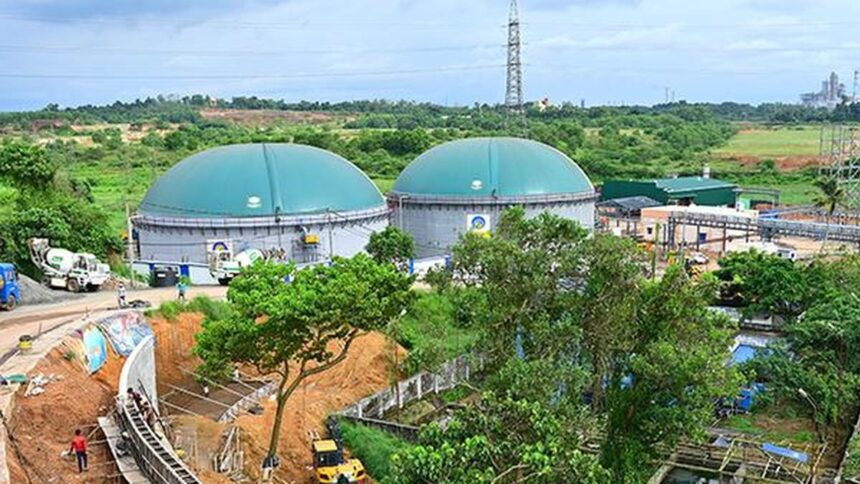
The capacity utilisation at the compressed biogas (CBG) plants in India is low at around 35 per cent due to various factors including difficulties in procuring adequate feedstock, said the International Energy Agency (IEA).
The IEA noted that the announcement of new projects, now being consolidated in the central Gobardhan registry, shows promising accelerated growth in upcoming years.
“The main challenge that could delay expansion is the currently low utilisation rate of existing plants (around 35 per cent) due to a number of factors, including difficulties in securing sufficient feedstock for continuous operation throughout the year, limited storage and market options for digestate, and logistics constraints to deliver CBG to end users,” it added.
In 2025, 79 per cent of CBG produced in India was delivered using pressurised cylinders transported on trucks (mobile cascades), but injection into gas grids, particularly in city gas distribution networks, is advancing alongside the broader development of gas infrastructure, the agency pointed out.
Currently, India has roughly 1,944 tonnes per day of commissioned CBG capacity.
As per the Gobardhan portal, the country has a total of 2,099 CBG plants registered. Of these, 1,344 plants are functional and another 96 plants have finished physical construction, but have trial runs, safety clearances, or commercial commissioning pending. Around 514 plants are under construction and another 155 are yet to begin construction.
Gobardhan, or the National Unified Scheme for Compressed Biogas, creates an integral framework to accelerate CBG production through assured offtake, stable pricing, capital assistance, pipeline connections and access to financing, with a budget of ₹23,700 crore.
It unifies previous support schemes across the value chain and sets long-term support to FY36, aiming to increase CBG production nearly tenfold. The CBG price is set at ₹2,110 per million British thermal units and capital assistance at up to ₹2 crore per tonne per day of installed capacity, including for feedstock aggregation, digestate processing and value addition.
Among major economies, the IEA noted that India has one of the highest feedstock potentials to produce biogas and biomethane (more than 75 billion cubic metres equivalent), mainly from agricultural residues and animal manure. State policies in the main agricultural states also favour development of the sector.
“India is expected to achieve exponential (almost ninefold) CBG production growth by 2031. If new plants can operate at capacity factors at least comparable with existing facilities, national blending targets appear to be within reach,” it added.
Published on November 11, 2026