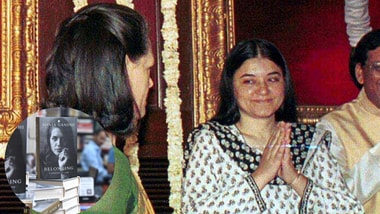
Sonia Gandhi’s memoir, , is grabbing headlines around the country as readers are eager to know the insides of India’s political circles and the Gandhi family, which was in the centre of power for the better part of the 80 years since India’s independence.
One of the most interesting aspects this book sheds lights on is the relationship Sonia Gandhi shared with her brother-in-law’s wife, .
In her book, Sonia Gandhi does talk about Maneka. She reveals that Sanjay Gandhi was introduced to his future wife in 1973 when she was “a pretty and vivacious girl, ten years younger than him and still a minor”.
Gandhi said that Sanjay and Maneka married the very next year once she turned 18. Sonia Gandhi describes Maneka’s younger version as a “high-spirited and talkative girl” who then became the Gandhi family’s “Choti Bahu”. She says the political fallout that happened latter could be called a “reality show” today.
“Maneka was…full of zest. It was refreshing at first to have a younger sister-in-law in the house. But slowly, the atmosphere began to change, with irritations cropping up in the home,” Gandhi writes in the book.
Gandhi reveals that she was called ‘Bahurani’ by the staff of the house and she had always considered Maneka and herself as “equal daughters of the house”.
“…but she probably saw it as a putdown. When she spoke rudely, by and large I’d remain silent to keep the peace, but when I felt it had gone too far, I wouldn’t hold back and would respond curtly,” Sonia reveals in her book.
She also talks about the rift between Sanjay and Maneka soon after their marriage, claiming that the couple’s quarrels would come to the notice of other members of the family when “the exchange of words between them became noisier and more heated”.
Sonia also claims that Maneka did not hesitate to even use foul language even in the presence of their mother-in-law, Indira Gandhi.
“When annoyed, she would use expletives, even in the presence of my mother-in-law, that were taboo in the home; they embarrassed him and shocked us. Living in our joint family couldn’t have been easy for a young girl with a sociable and gregarious temperament,” Sonia writes.
Sonia Gandhi also reveals that Maneka’s influence on her husband drove a ridge between the erstwhile inseparable brothers, Sanjay and Rajiv.
She says as Sanjay’s name became closely associated with the Emergency, he began voicing his opinions on the “slow workings of the bureaucracy” and even said some things that were perceived to be critical of his own mother, the prime minister.
Sonia recalls one family discussion in which Rajiv lashed out at Sanjay Gandhi as he believed his younger brother was responsible for the Congress’ disastrous performance in the 1978 elections.
“He felt that Sanjay had contributed in great measure to the calamitous outcome: his stubbornness, his impetuosity, his rush to implement programmes that weren’t well thought out, his unwillingness to heed well-meant admonitions, his acting in many instances without his mother’s knowledge,” the book reads.
“I cannot forgive you, Sanjay, you have brought Ma to this pass,” Rajiv reportedly said at a family discussion.
“Maneka intervened, and my mother-in-law, raising her voice, challenged her to deny it. She quickly retreated, but her animosity towards us only increased,” Sonia recalls.
“As far as she was concerned, we were enemies. She spread stories about us through journalists with whom she was in touch. The one that galled us most was the outright lie that Rajiv and I had intended to flee the country when the elections were lost,” Gandhi adds.
After Maneka was denied a senior leadership position in the party when Sanjay died in a plane crash in 1980, Gandhi says “it became clear that she had her sights set elsewhere.”
When Indira suggested a small gathering for the first birthday of Feroze Varun Gandhi, “She learnt later that a birthday party for her grandchild had indeed taken place but in the house of Vasundhara Raje, the daughter of the dowager Rajmata of Gwalior, a staunch supporter of the RSS and a political opponent of Mrs. Gandhi. It was clearly intended to wound her,” Sonia says.
She also recalls how Raje facilitated the sale of the Surya magazine of Maneka’s to a member of the RSS.
This event, Sonia says, was “tantamount to insulting not only her (Indira) but the memory of her son, of her father, of all those who had fought against the RSS’s communal ideology since the days of the struggle for Indian independence”.
“With this act Maneka had crossed all limits. To my mother-in-law, it was a deliberate challenge.”