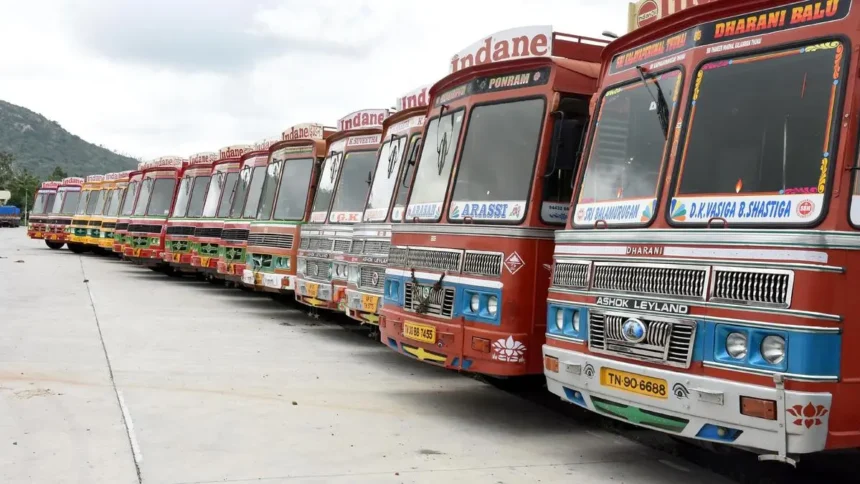
India’s commercial-vehicle market is witnessing a twin surge in conventional freight trucks and electric commercial vehicles, even as buses struggle to keep pace, signalling a shift towards infrastructure-led haulage and cleaner urban logistics.
Goods-carrier registrations jumped 21.4% to 9.05 lakh during January-October 2026 from 7.45 lakh a year earlier, while bus registrations edged up just 1.8% to 1.13 lakh, according to VAHAN data. Electric commercial-vehicle registrations, meanwhile, surged 162.3% to 4,942 units in October, accounting for 4.29% of total CV retail sales.
Federation of Automobile Dealers Associations (FADA) President Sai Giridhar said commercial vehicles, three-wheelers and tractors recorded their best-ever October retail volumes. Dealers identified infrastructure, mining and freight movement as key demand drivers, with 50.41% expecting further CV growth during November-January.
Ashok Leyland Chief Marketing Officer Sanjeev Kumar has indicated that expanding light commercial vehicle (LCV) volumes could provide greater stability as heavy-truck demand moves through cycles, reflecting how manufacturers are balancing infrastructure-led haulage with last-mile freight opportunities.
October retail figures reinforced the divergence. Heavy commercial-vehicle registrations jumped 28.95% to 36,879 units, while medium commercial vehicles grew 21.16% to 9,042. Light commercial vehicles, however, declined 9.57% to 69,148.
Overall CV retail sales rose 2.29% to a record 1,15,140 vehicles, highlighting an uneven recovery across segments.
Within the emerging electric CV segment, Tata Motors led with 1,740 registrations and a 35.2% market share in October. Euler Motors followed with 1,272 vehicles and a 25.7% share, while Mahindra Last Mile Mobility ranked third with 538 registrations and a 10.9% share.
Together, the three manufacturers accounted for nearly 72% of electric CV registrations. Switch Mobility and JBM Auto are among the other players competing in electric buses and fleet transportation.
Ashok Leyland’s October medium and heavy truck dispatches jumped 40.6% to 11,613 vehicles from 8,257 a year earlier, while bus volumes declined 11.3% to 2,314. LCV dispatches grew 14.5% to 7,961.
The contrasting performance underscores why the Hinduja Group company is widening its cargo portfolio to compete more directly with Tata Motors across vehicle categories.
Tata Motors led October CV retail sales with 39,914 registrations, up 11.2%, commanding a 34.67% market share.
Its wholesale dispatches climbed 27% to 47,652 vehicles, supported by a 225% increase in international sales. Domestic volumes grew 13%, with heavy trucks rising 12%, intermediate and light-medium trucks 17%, and passenger carriers 20%.
During January-October, Tata led goods-carrier registrations with 3.06 lakh vehicles and a 33.8% market share, followed by Mahindra at 2.50 lakh and Ashok Leyland at 1.65 lakh.
Tata also led bus registrations with 36,656 vehicles, ahead of Force Motors and Ashok Leyland.
Volvo Eicher Commercial Vehicles’ October dispatches increased 34.9% to 10,861 vehicles, although domestic bus volumes declined.
Mahindra’s truck and bus division reported 82% dispatch growth to 1,773 vehicles, with cargo volumes more than doubling to 1,504. Its SML Mahindra business recorded largely flat dispatches at 1,065 vehicles, while domestic sales fell 3.7%.
SML Executive Chairman Vinod Sahay attributed growth to festive demand, freight movement and infrastructure activity, while also flagging input-cost pressures.
Across April-October, combined MTBD and SML dispatches rose 24% to 20,643 vehicles. SML’s passenger-vehicle volumes increased 17% to 7,339, highlighting resilient demand in select bus categories despite a slower industry-wide trend.
India’s CV market is increasingly moving at three speeds: heavy trucks benefiting from infrastructure and industrial freight, smaller cargo vehicles facing uneven demand, and electric commercial vehicles gaining ground in urban logistics. Manufacturers with diversified portfolios are better positioned to navigate these contrasting demand cycles,” said an industry analyst.
Published on November 10, 2026