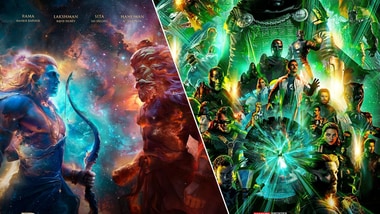
From Hollywood’s Marvel Cinematic Universe to India’s ambitious adaptation of Ramayana, the film industry appears increasingly interested in building franchises rather than making standalone films. Sequels, spin-offs, crossovers and interconnected cinematic universes have become a major part of how studios plan their biggest releases.
Two upcoming and recent examples underline this trend. Marvel Studios’ brings together characters from different corners of its cinematic universe, while Nitesh Tiwari’s has been planned as a two-part theatrical saga, with its makers also considering the possibility of expanding it further.
The question, however, is whether the industry is becoming too dependent on familiar properties to bring audiences into cinemas. Does an established franchise make a film an easier sell, or can an original story still achieve the same level of success?
For film studios, franchises offer something valuable: an existing audience. When viewers are already familiar with a character, fictional world or storyline, there is a certain level of even before a film reaches theatres.
is one of the biggest examples of this approach. Over the years, the studio has built an interconnected universe through individual superhero films, ensemble projects and major crossover events. Avengers: Doomsday, scheduled for release in December 2026, is another major chapter in that larger story.
Lawyer and film blogger Yash Gokhale shed light on the unpredictable nature of movies and said, “It’s the cyclical nature of the ups and downs of the movie business. After every economic crisis, risk-taking takes a morale loss, and producers bank on familiarity. Superhero movies took off after 9/11 and the MCU started after the ’08 financial crisis. Given the sea change in home entertainment over the last decade and especially after COVID-19, it would make sense for the producers to feel even more selective about what actually brings people into theatres.”
The film features characters from different Marvel properties, including the and Fantastic Four, alongside familiar Avengers. Its appeal is not limited to one superhero or storyline. It brings together several characters and storylines that audiences have followed over the years.
A similar approach is taking shape with Ramayana. Produced by Namit Malhotra and directed by , the film stars Ranbir Kapoor as Rama, Sai Pallavi as Sita and Yash as Ravana. The first instalment was released on November 5, 2026, while the second part has been pushed to 2028.
Malhotra has also indicated that the possibility of a third instalment has not been ruled out, depending on audience feedback. The larger ambition is to create a cinematic world around one of India’s most familiar epics, with room for more stories and characters.
Full-time, firecely loyal cinephile Abrar specifically talked about how the familiarity of the Avengers universe brings him a certain sense of comfort. He said, “Growing up has left a big impact on the way I see cinema and celebration of characters. Fans like me love the long game, connected stories, easter eggs, references to other characters and theories. So a shared universe actually gives us something to follow for years.”
“A new world is always welcome, but I love spending more time with these characters. The way their character is treated throughout their whole arc, is really something really personal. Anytime a single one off movie would end, I would wonder what happened to that specific world and the characters associated with it. And that’s where these franchises showed me a way to spend more time with these characters and stories.”
For producers, such projects offer the possibility of keeping audiences invested beyond a single theatrical release. They also create opportunities for merchandise, spin-offs and other forms of entertainment built around the same property.
Despite the growing interest in cinematic universes, film distributor Akshay Rathi believes franchises are not the only way to bring audiences into theatres.
He pointed out that familiarity can certainly help a film, but its success ultimately depends on what it offers viewers.
Prominent Indian film exhibitor, cinema owner, and entertainment entrepreneur Akshay Rathi said, “Films are being turned into franchises, and a lot of them actually do well because of the familiarity of the universe they bring to the table and the audience’s eagerness to consume them. But it’s not as though franchises are the only films doing well.”
Rathi also backed this idea, “If you look at recent times, Hanuman Ansh, a standalone film, did really well. In Hollywood, too, did incredibly well. There are so many films that have come along, which haven’t been part of any franchise, yet have performed exceedingly well. And that’s been the case time and again.”
Rathi’s examples underline an important point. , the 2024 Telugu superhero film starring Teja Sajja, became a major box-office success without depending on an established series of films. Similarly, Christopher Nolan’s The Odyssey, released in July 2026, demonstrated that a film based on an ancient literary work could attract a massive theatrical audience without being part of a modern cinematic franchise.
The latter went on to collect more than $1.6 billion worldwide, according to , making it one of the biggest non-franchise films in box-office history.
Rathi believes that audiences may be drawn to familiar characters, but that alone cannot make a film successful.
He added, “So ultimately, it’s not the value of a franchise or a universe that brings audiences to theatres. Sure, it does bring familiarity, but it’s the merit, engagement and entertainment value of a film that really turn it into a box-office hit or a money-spinner.”
He also does not believe that expanding a story into multiple films is necessarily a bad decision.
“And I really think that whether it’s , Ramayana or any other film, if certain stories are worthy of lending themselves to spin-offs, universes, franchises, sequels, etc., there’s absolutely no harm in that. Simply because some stories deserve to be told in a manner that allows audiences to savour them over multiple films,” Rathi concluded.
Ultimately, the issue is not whether films should become franchises. Some stories are simply too large to be told in a single film, while certain characters deserve to be explored through multiple narratives.
However, the industry must also recognise that audiences are not committed to a franchise just because they watched its previous instalments. They still expect a good story, engaging characters and an entertaining experience.
A familiar universe may get people interested in a film, but it cannot replace the need to make a good one.