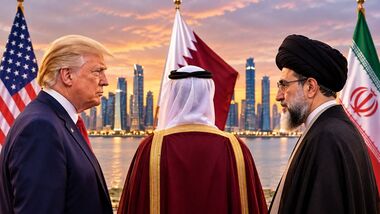
More than eight months into the war between the and Iran, several countries have stepped forward to broker a deal and take part in regional efforts to end the conflict and prevent further escalation. While Pakistan took a prominent role in the diplomatic push, with leaders from both sides meeting in Islamabad in April, another country that had largely worked behind the scenes is now positioning itself as a key mediator in talks between Washington and Tehran: .
The Gulf nation had previously distanced itself from direct mediation efforts after coming under attack from Iran, saying that it would support Pakistan-led efforts. However, it has since re-engaged in the diplomatic process and is continuing its efforts to prevent further escalation.
On Friday (local time), Qatari Prime Minister and Minister of Foreign Affairs Sheikh Mohammed bin Abdulrahman bin Jassim said during a public interview at Oxford University that mediation efforts remain active to prevent a major escalation in the region. He warned that the crisis “cannot be left unresolved”, Al Jazeera reported.
Thani said, “For the past couple of weeks, we have worked with colleagues in the US administration who have very genuine intentions to find a way to contain the situation and de-escalate it”. He further said that mediation efforts continue “to prevent the situation from spiralling out of control,” and added, “thanks also to some wise voices in Tehran, we have prevented that from getting out of control”.
The Qatari PM’s remarks came a day after Reuters reported that Iran had sent the US a nuclear proposal via Qatar. The proposal is to be discussed only after Washington agrees to meet Tehran’s seven demands, which Iran included in a seven-day ceasefire proposal in September that US President rejected.
The latest proposal highlights Qatar’s growing involvement in efforts to bring Washington and Tehran closer to an agreement. However, Doha’s role in the diplomatic process has not always been as prominent, with the Gulf nation initially reluctant to take on direct mediation after coming under Iranian attack.
Earlier in March this year, nearly a month after the US and launched a joint operation against Iran, Qatar’s foreign ministry spokesperson told Reuters that there was no direct Qatari mediation between the two countries, but added that Doha supported all formal and informal diplomatic channels to end the war.
However, two months later, a Qatari negotiating team visited Iran in May, in coordination with the US, to try to help secure a deal to end the war and resolve outstanding issues, Reuters reported. Doha, which has worked as a mediator in the war and other areas of international tension, had distanced itself from playing a mediation role after coming under attack from Iranian missiles and drones.
According to a report by The National News dated June 16, Doha, which hosts the largest US base in the region and has a long history of acting as a diplomatic bridge between adversaries, changed its stance in May. It reportedly refused to enter negotiations under Iranian fire but hosted an Iranian delegation after a ceasefire was in place to discuss the release of frozen funds.
Qatar’s re-engagement came despite having launched hundreds of missiles and drones at the country, targeting civilian infrastructure and its vital liquefied natural gas (LNG) production facility at Ras Laffan. The attack wiped out roughly 17% of the country’s LNG export capacity. Qatar had already halted LNG production on March 2 following Iranian strikes.
A report by The New Arab dated June 16, citing analysts and diplomats, said Qatar’s role was less about formal mediation this time and focused more on facilitating communication.
Tehran received several high-level Qatari delegations, with one visit taking place just hours before the agreement was announced. Discussions during earlier trips centred on key issues that had stalled negotiations, including Iran’s nuclear programme, frozen assets, regional security and arrangements for navigation through the .
Qatari Prime Minister and Foreign Minister Sheikh Mohammed bin Abdulrahman Al Thani also visited Washington twice, first in late March and then again in mid-May. During the visits, he held discussions with US Vice President on the regional conflict and the conditions needed to reach an agreement.
In another diplomatic engagement in late May, Doha welcomed a senior Iranian delegation comprising Parliament Speaker Mohammad Bagher Ghalibaf, Foreign Minister Abbas Araghchi and Central Bank Governor Abdolnaser Hemmati. The talks reportedly addressed the release of frozen Iranian assets, maritime security, confidence-building measures, and the reopening of the Strait of Hormuz.
Doha’s renewed diplomatic involvement comes at a crucial time as Washington and Tehran continue to explore a way out of the conflict despite disagreements over the Islamic Republic’s nuclear programme and other regional issues. While Pakistan has played a prominent public role in the peace efforts, Doha’s ability to maintain communication with both sides has made it an important part of the diplomatic process. Whether its latest efforts can help bridge the remaining differences and bring the two countries closer to an agreement remains to be seen.