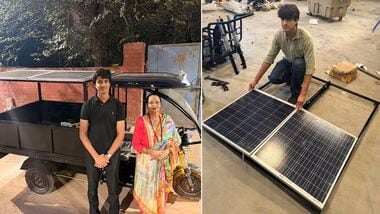
A 17-year-old student from Gurugram has developed a functional, solar-powered three-wheeler for just over ₹1 lakh to make commercial transportation accessible to lower-middle-income families.
According to a report by India Today, Akshit Khera was inspired to build the vehicle after a conversation with his housemaid’s family, who could not afford the ₹1.5 lakh- ₹2 lakh upfront cost of a conventional electric loader to start a cargo business.
“I spoke to about 20 more families, and it became clear that there was a real need for an affordable, low-running-cost vehicle that could serve different purposes,” Akshit told India Today.
Subsequently, the Heritage International Experiential School student set out to design a multi-purpose capable of hauling goods without putting financial pressure on working-class drivers.
According to the online publication, Akshit initially envisioned a fully solar-powered car but pivoted to a more practical solar-assisted design based on seasonal sunlight calculations. “I was clear from the start that I wanted to build something that works, not just a simulation,” he said.
The final prototype features a weatherproof two-seat cabin, a cargo box with a 300 kg capacity, and a 400W monocrystalline acting as a protective canopy, India Today reported.
The three-wheeler delivers a 50 km range on a single charge, with the solar panel supplying an average of 63 per cent of its daily electricity needs. This brings the running cost down to an estimated 13 paise per kilometre.
When early estimates reached ₹1.35 lakh, Akshit optimised the design to keep production costs low.
The publication said that he reduced the lithium-ion battery capacity to 3.072 kWh, restricted heavier steel tubes strictly to key load-bearing points to shave off 26 kg, and negotiated component prices at Delhi’s Mayapuri automobile market, ultimately bringing the total build cost to ₹1,02,536.
Finding a fabricator willing to take on a teenager’s project was a major hurdle, India Today said, noting that Akshit was rejected by more than a dozen workshops across Delhi, Gurugram, and Faridabad. He eventually found a fabricator named Arun who agreed to build the chassis.
Technical challenges also forced immediate design pivots — Because the 400W solar panel operated at a lower voltage than the battery, Akshit had to discard his planned buck charge controller and redesign the electrical system around a boost controller. He also swapped out a planned plywood cargo floor for painted steel sheets to prevent water damage during monsoons.
Reflecting on the rigorous process, Akshit told India Today, “I didn’t have a workshop, a team of engineers or a big budget. I had a question, some school maths and physics, and a lot of curiosity.”
His parents, Amit Khera, a senior partner at McKinsey & Company, and Kanchan Khera, CEO of Zykrr Technologies, supported him through months of calculations and visits to workshops.
Currently undergoing real-world testing, the vehicle is still a prototype.
Akshit plans to donate this first iteration to a family in need while exploring partnerships with established automobile manufacturers to scale production, India Today reported.
He estimated that mass manufacturing could reduce costs by an additional 10-20%. However, he remained steadfast about the vehicle’s core mission of affordability. “If the partnership turned it into a premium product, it would miss the point,” he asserted.
Looking ahead to higher studies in mathematics and engineering, the young innovator envisions future upgrades for his concept, including swappable batteries, lighter solar cells, and shared solar charging networks for gig workers and e-rickshaw drivers.