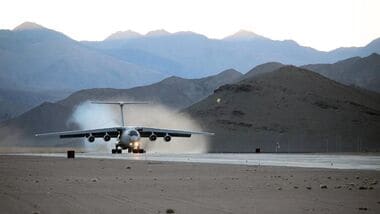
An Indian Air Force (IAF) IL-76MD heavy-lift transport aircraft has landed at the Nyoma airbase in eastern Ladakh at an altitude of 13,629 feet, setting a world record for the highest-altitude landing by an aircraft of its class.
The achievement marks a significant milestone in India’s strategic airlift capabilities, demonstrating the ability to operate heavy military transport aircraft in some of the world’s most challenging high-altitude terrain. It also strengthens India’s logistical reach close to the Line of Actual Control (LAC) with China.
The four-engine aircraft, known as the ‘Gajraj’, landed at the airbase on Friday. Located approximately 25 km from the , Nyoma is emerging as a key military infrastructure asset for India’s forward deployment and logistical operations in eastern Ladakh.
The development comes amid continued military sensitivities along the India-China border. Although the two countries have completed disengagement at several friction points and resumed patrolling arrangements since October 2024, a complete de-escalation of troops in eastern remains a broader strategic concern.
The successful landing demonstrates the IAF’s ability to operate a heavy strategic transport aircraft at an altitude where thin air, reduced engine performance and difficult terrain pose considerable operational challenges.
The IL-76MD can approximately 40–45 tonnes of cargo, depending on its configuration and operating conditions. This includes heavy military equipment and platforms such as infantry combat vehicles and other armoured assets.
Its ability to land at Nyoma could significantly improve the movement of troops, equipment and supplies to forward areas, reducing dependence on airfields located farther from the China border, including Leh and Thoise.
The aircraft also played an important role during the 2020 India-China military standoff in eastern Ladakh, when the IAF used its heavy-lift capabilities to transport military equipment and other essential assets to the region, according to an Indian Express report.
The IAF announced the latest achievement in a post on X, describing it as a “remarkable demonstration of the aircraft’s enduring capability”, backed by the skill, precision and professionalism of its crew.
It added that the landing was a milestone reinforcing India’s strategic capabilities.
The landing also highlights the growing operational importance of the Nyoma airbase, which has been developed as a strategic military facility close to the LAC.
The airfield, located in the Nyoma subdivision of Leh district, was originally constructed in 1962 as a mud-paved landing ground but remained largely inactive for several decades.
It was reactivated in 2009 after an AN-32 aircraft successfully landed there, demonstrating its potential for military operations.
Following the 2020 border standoff with China, the airstrip supported the operations of several aircraft, including the C-130J and AN-32 transport aircraft, as well as Apache attack helicopters and Chinook heavy-lift helicopters.
The airbase was subsequently upgraded under a Border Roads Organisation () project estimated at around ₹214–218 crore, as per Indian Express.
Its approximately 2.7–3-km runway, built with a rigid pavement surface, is designed to support the operations of military transport aircraft and fighter jets.
Nyoma’s proximity to the makes it particularly important for rapid mobilisation. The ability to move heavy equipment and personnel directly to a forward airbase could reduce logistical turnaround times and strengthen India’s capacity to sustain troops deployed in eastern Ladakh.
The facility is especially valuable given the region’s difficult geography and extreme weather conditions.
Situated in the cold-desert terrain of the Changthang plateau, Nyoma experiences temperatures that can fall to around –30°C.
Its high altitude and rugged mountainous surroundings also make infrastructure construction and aircraft operations challenging, with the construction window limited to a few months each year.
The IAF has demonstrated its ability to operate military transport aircraft at extreme altitudes in eastern Ladakh before.
In 2013, an IAF C-130J Super Hercules successfully landed at the Daulat Beg Oldie (DBO) airstrip, situated at an altitude of approximately 16,614 feet. That landing demonstrated the IAF’s ability to operate transport aircraft at even higher elevations.
However, the latest Nyoma landing is significant because of the aircraft involved. Unlike the C-130J, the IL-76MD is a much heavier strategic transport aircraft, with a substantially larger payload capacity.
Operating an aircraft of this size at high altitude presents additional challenges because thinner air reduces lift and engine performance, requiring careful calculations of payload, runway requirements and operating conditions.
The successful landing therefore demonstrates a different dimension of India’s strategic airlift capability, particularly its ability to transport heavier military equipment closer to forward deployment areas.
Despite the achievement, the landing also draws attention to the challenges facing India’s ageing strategic transport fleet.
India acquired 17 IL-76 aircraft between 1985 and 1989, making the Gajraj fleet one of the oldest heavy-lift assets. The aircraft have faced serviceability challenges over the years, particularly because of difficulties in sourcing spare parts following the collapse of the Soviet Union. These challenges have been further complicated by the Russia-Ukraine war.
There have been discussions about extending the technical service life of around a dozen IL-76 . At the same time, the is pursuing its Medium Transport Aircraft (MTA) programme, which is intended to replace both the IL-76 and AN-32 fleets.
The latest landing at Nyoma is significant not only as an aviation milestone but also as a demonstration of the capabilities India continues to rely on to maintain military readiness along its disputed border with .