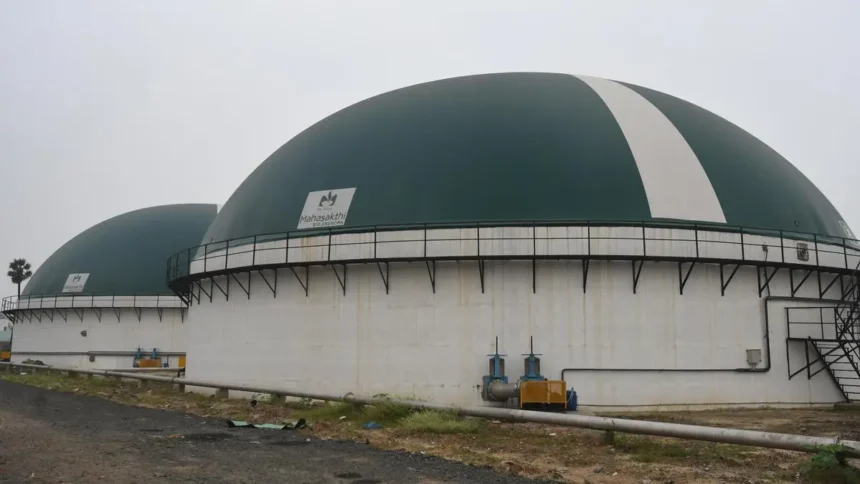
Gujarat Energy Ltd (GEL), India’s largest city gas distribution company by sales volume, plans to set up around 200 tonnes per day (TPD) of compressed biogas (CBG) production capacity in the initial phase, with 100 TPD proposed in Gujarat and the remaining 100 TPD outside the State, as it looks to diversify its gas sourcing portfolio and gradually reduce dependence on imported liquefied natural gas (LNG).
The Gujarat government-owned PSU has issued an expression of interest (EOI) inviting joint venture (JV) partners to set up and operate CBG plants, with the proposed initiative involving an investment of around ₹100 crore, according to the management. “We have initiated our entry into the CBG ecosystem and have issued an EOI seeking partners to set up CBG plants. This initiative will support our CBG blending requirements, leverage existing natural gas infrastructure and in the long run reduce dependence on imported LNG,” Avantika Singh, Managing Director of Gujarat Energy, told investors on Friday.
According to the EOI, the proposed initial capacity of 200 TPD will be split equally between Gujarat and locations outside the State, with 100 TPD planned in each. The company intends to develop individual plants with capacities ranging from 10 TPD to 20 TPD, depending on feedstock availability in the respective catchment areas. GEL is proposing to hold a 49 per cent stake in the joint venture companies, with selected partners holding the remaining 51 per cent. The JV companies will own and operate the CBG plants, while Gujarat Energy will support the offtake of the gas produced through its city gas distribution (CGD) network.
The company is looking to use a mix of agricultural and organic waste as feedstock, including paddy straw, press mud, Napier grass, cattle dung, poultry litter and other agricultural residues. The feedstock mix for each plant will be finalised based on its availability in the surrounding catchment area. The proposed plants will be located either within GEL’s CGD geographical areas or near the natural gas pipeline network of Gujarat Integrated Gas Ltd (GIGL), allowing the CBG produced to be injected into and marketed through the company’s distribution network or the GIGL pipeline.
The initiative is aligned with the Centre’s GOBARdhan programme and the CBG Blending Obligation (CBO) applicable to the CGD sector, which requires gas distributors to progressively incorporate compressed biogas into their natural gas supply mix. The move comes as GEL continues to strengthen its long-term LNG procurement portfolio. The company imported 24 LNG cargoes in the first half of FY27, compared with 14 in the corresponding period last year, and is targeting a sourcing portfolio of around 4 million tonnes per annum (MTPA).
The company is also exploring the development of six liquefied natural gas (LNG) fuelling stations across its geographical areas (GAs), as the city gas distributor looks to tap the potential of LNG-powered heavy commercial vehicles and expand beyond its conventional CNG and PNG distribution business.
The proposed stations are aimed at supporting the adoption of LNG in long-haul transportation, an emerging segment for gas distribution companies seeking to increase natural gas consumption in the road transport sector. “We are also exploring the development of six LNG stations in our GAs with the objective of supporting the adoption of LNG in long-haul transportation,” Singh, added.
The proposed expansion would add another segment to the company’s existing gas distribution operations, which include CNG stations for vehicles, domestic and commercial PNG connections and industrial gas supplies. LNG is being explored as an alternative fuel for heavy-duty trucks operating over long distances. Its potential in this segment stems from the possibility of using liquefied natural gas in vehicles requiring higher fuel storage capacity and longer driving ranges than conventional CNG-powered vehicles.
The company has already built a domestic PNG base of approximately 25.3 lakh connections, alongside around 17,000 commercial and 4,500 industrial connections.
Published on November 7, 2026