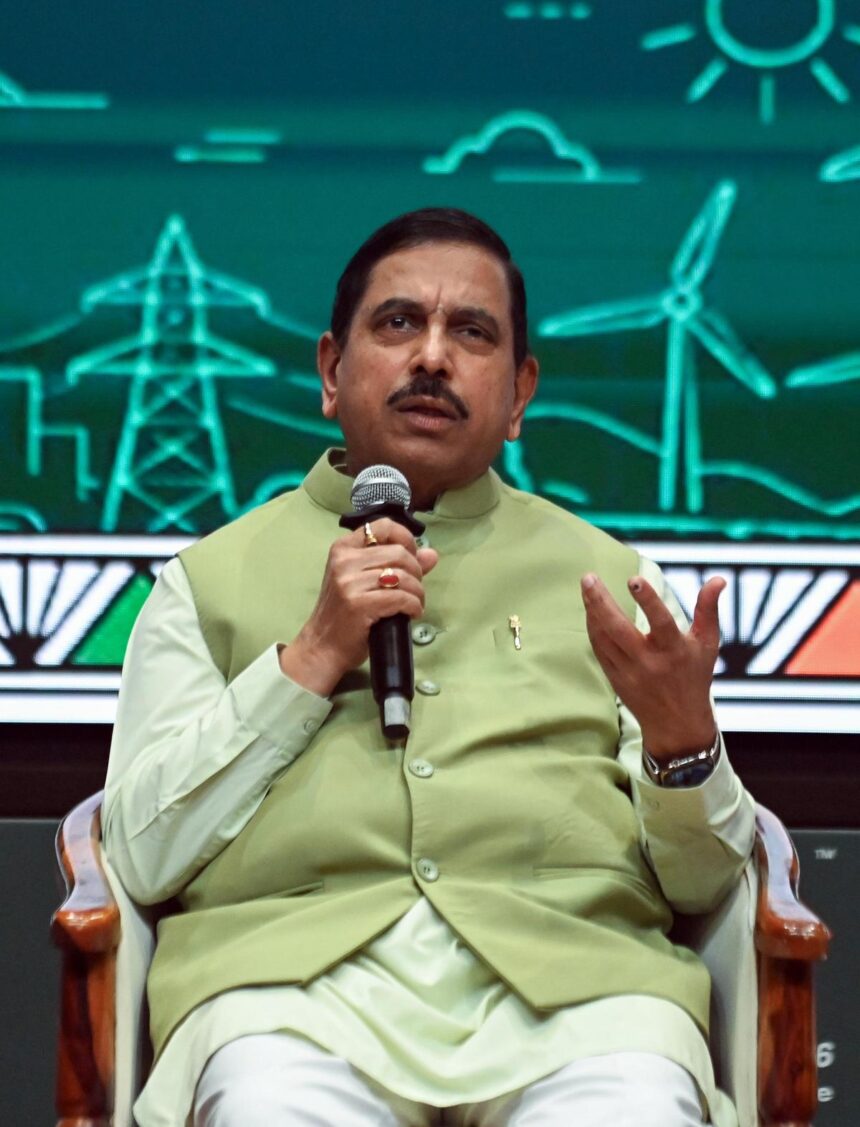
The Minister for New & Renewable Energy Pralhad Joshi said on Wednesday that the CEO roundtable at the Bharat Renewable Energy Summit & Expo witnessed investors making commitments worth $400 billion in the clean energy sector.
However, the $400-billion figure was preliminary and that details of individual investors, sectors and proposed investments were yet to be worked out by the Ministry, he clarified.
“Fund managers, they have taken all the details, and in the CEO roundtable, they have given a commitment of $400 billion. So, that details, we are going to work out,” Joshi told reporters.
Joshi informed that the investment discussions covered renewable energy, green hydrogen, energy storage and transmission infrastructure, with participation from domestic and international investors.
He said the government would examine the proposals before providing a detailed account of the commitments made by individual companies and fund managers.
On concerns that the West Asia conflict could divert global investment towards rebuilding damaged energy infrastructure, Joshi said investors continued to view India as an attractive destination.
Separately, the Minister said the government would hold consultations over the next 10-15 days before deciding whether to further extend the relaxation granted to solar projects under the Approved List of Models and Manufacturers (ALMM) framework for solar cells.
India’s domestic solar cell manufacturing capacity currently stands at around 47 GW, while manufacturers have indicated that capacity could reach 70 GW by December 31, he said.
The government had earlier extended the relaxation until December 31 following concerns over inadequate domestic manufacturing capacity.
“Some people want to extend it. Some people do not want to extend it. So, we will listen to them,” Joshi said.
On the Cabinet’s approval of ₹14,500 crore in viability gap funding for grid-scale energy storage, Joshi said the scheme would support pumped hydro and battery storage projects, helping address fluctuations in renewable power generation.
He cited a recent round-the-clock renewable power tender at ₹5.25 per unit, arguing that competitive bidding and storage infrastructure could help make renewable electricity economical for consumers.
Responding to concerns over rooftop solar and net metering, Joshi said several State governments were considering decentralised battery storage solutions for individual households to manage peak-hour electricity demand.
He clarified that these were proposals being considered by states and not an announced Central government scheme.
The Minister also expressed confidence that the PM Surya Ghar programme would achieve its target of one crore households by March, while indicating that any decision on expanding the target would require further consultations.
Published on November 4, 2026