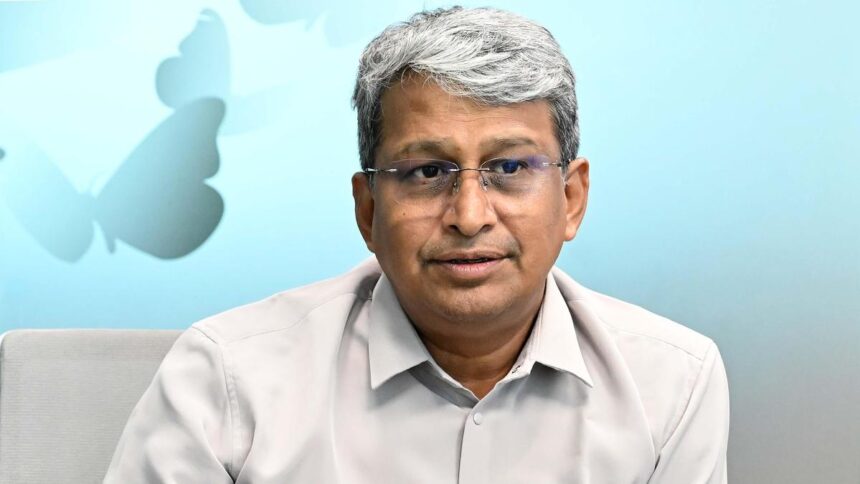
Healthcare major Kauvery Hospitals is embarking on its fastest expansion phase yet with plans to double its bed capacity from around 2,500 to 5,000 over the next three to four years, Dr. Manivannan Selvaraj, Founder and Managing Director, Kauvery Group of Hospitals, said.
As the Chennai-headquartered healthcare group looks to deepen its presence across South India, the expansion will involve adding capacity at existing facilities in Tamil Nadu and Bengaluru, and entering additional cities, including Madurai and Coimbatore, among a few others, he told businessline in an interaction.
“This is the fastest growth phase for us now that we have built capabilities and have a strong team,” Selvaraj said.
The multi-specialty hospital chain has an overall revenue of ~₹2,600 crore and employs nearly 18,000 people. It was founded in 1999 with a 30-bed hospital in Trichy. The group acquired listed entity KMC Speciality Hospital in 2009, which helped it secure private equity funding and eventually entered Chennai in 2012. In a competitive market, it broke even within two years, giving the chain the confidence to replicate the model further.
Today, it has 12 hospitals across Tiruchi, Chennai, Salem, Hosur, Tirunelveli, and Bengaluru. It is also adding a large hospital in North Chennai.
On funding its growth plans, Selvaraj says they have built internal accruals and are not in a hurry to tap the public markets. “We have spoken to bankers to understand the market conditions, but have not evaluated any specifics like pre-IPO rounds,” he said. The group’s last fund-raise was around three years ago, and most of its hospitals have matured into cash-generating units, he added.
Kauvery’s expansion plans come at a time when hospitals are grappling with rising operating and capital costs. “We are trying to manage this by improving operational efficiency,” he said.
One, it has centralised several non-clinical functions such as HR and finance, at Tiruchi. It is also leveraging digitally-connected ICUs so that critical care physicians are able to monitor patients across locations.
“We spend around 3-3.5 per cent of our turnover on technology across ERPs, hospital management systems and cybersecurity,” he adds.
On AI, Selvaraj sees near-term opportunities in back-end operations and clinical documentation. “It is going to assist doctors, not replace doctors,” he said.
Amid recent scrutiny on pricing by hospitals, Selvaraj says any analysis of pricing should be preceded by an understanding of the cost of delivering care.
Cost of consumables and several imported high-end medical equipment had increased by nearly 30 per cent over the last year, while construction costs had risen by around 20 per cent, he said. “It’s a complex issue; we have to manage patient, government and regulator expectations,” he said. Expanding the insurance base will help improve the economics of healthcare delivery, he adds.
As for their differentiation in a competitive market, Selvaraj says it comes from their roots in Tiruchi. “We believe that people in any region should not travel outside the city for good healthcare and aim to provide tier-1 quality across tier-2 towns,” he said.
Published on November 4, 2026