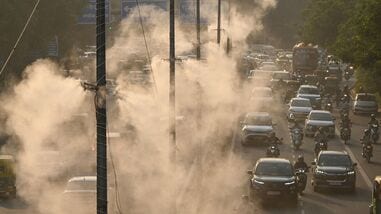
Delhi’s air quality worsened further on Tuesday morning, with the city’s average climbing to 331 at 7 am, compared with 307 at the same time on Monday. The air quality remained in the ‘very poor’ category, with PM2.5 emerging as the dominant pollutant, according to real-time data from the Central Pollution Control Board (CPCB).
Pollution levels remained high across most parts of the national capital. Out of 58 monitoring stations that reported valid readings, 57 recorded AQI levels above 200, while 41 stations registered readings exceeding 300. As many as eight locations reported AQI levels above 400, placing them in the ‘severe’ category.
Jahangirpuri emerged as the most polluted location in Delhi, with an AQI of 449. Rohini followed with a reading of 429, while Punjabi Bagh recorded 424. Alipur and Vivek Vihar reported AQI levels of 413 and 410, respectively.
Other locations that crossed the 400 mark included Bawana (408), and Narela (406). In comparison, IGNOU-Maidan Garhi recorded the lowest AQI in the city at 195.
The impact of rising pollution was also visible across several neighbouring cities in the National Capital Region (NCR).
Noida registered an AQI of 307, while Manesar recorded 302. Gurugram’s reading stood at 284, followed by Ghaziabad at 259 and Greater Noida at 213. Faridabad reported comparatively better air quality, with an AQI of 111, placing it in the ‘moderate’ category.
According to the CPCB’s National Air Quality Index classification, an AQI between 201 and 300 falls under the ‘poor’ category. Readings ranging from 301 to 400 are classified as ‘very poor’, while values between 401 and 500 indicate ‘severe’ air quality.
Extended exposure to ‘very poor’ air can lead to respiratory illnesses. In the ‘severe’ category, air pollution can adversely affect even healthy individuals, while posing serious health risks to people with existing respiratory and cardiovascular ailments.
The CPCB dataset, which covered 272 cities with valid AQI readings, showed Gajraula in Uttar Pradesh as the most polluted city in the country, with an AQI of 399.
Delhi and Khora in Uttar Pradesh occupied the next positions, both recording an AQI of 331. Haryana’s Kaithal followed with a reading of 330. Baraut in Uttar Pradesh registered 310, while Noida and Hapur recorded AQI levels of 307 and 306, respectively.
On the other hand, several cities reported clean air. Amaravati in Andhra Pradesh had the lowest AQI at 18, followed by Madikeri in Karnataka at 19 and Gangtok in Sikkim at 23. Nayagarh in Odisha recorded 24, while Chikkamagaluru in Karnataka stood at 25. All five cities were in the ‘good’ air quality category.
The latest spike in pollution comes a day after the Commission for Air Quality Management (CAQM) enforced Stage II of the Graded Response Action Plan (GRAP) across Delhi-NCR with immediate effect.
The decision was announced on Monday after Delhi’s AQI touched 324 at 4 pm, pushing the city into the ‘very poor’ category. The CAQM attributed the worsening conditions to unfavourable weather and forecasts issued by the India Meteorological Department (IMD) and the Indian Institute of Tropical Meteorology (IITM).
According to the agencies’ projections, Delhi-NCR’s air quality was expected to remain in the ‘very poor’ category over the next few days.
1. Diesel Generator (DG) Sets: The use of diesel generator sets for regular or commercial purposes is prohibited, with exemptions limited to specified emergency and essential services.
3. Coal- and firewood-fired Tandoors: Restaurants, hotels and eateries cannot operate tandoors fuelled by coal or firewood.
4. Construction and demolition: Reopening construction and demolition sites or industrial units that have been specifically ordered to shut down is not permitted.
5. Vehicles without valid PUC certificates: Vehicles without a valid Pollution Under Control (PUC) certificate face enforcement action, including penalties and possible denial of fuel at petrol pumps.
6. Older and non-compliant commercial vehicles: Restrictions may apply to the entry and movement of older or non-compliant interstate commercial and goods vehicles in Delhi-NCR, depending on the applicable emission standards and government notifications.
3. Anti-pollution activities: Mechanised road sweeping, regular water sprinkling with dust suppressants and targeted pollution-control measures will continue across Delhi-NCR.
4. Regular traffic and essential operations: Compliant vehicles carrying valid PUC certificates can continue plying under normal traffic regulations. However, authorities may increase parking charges and introduce staggered office timings to discourage private vehicle use.