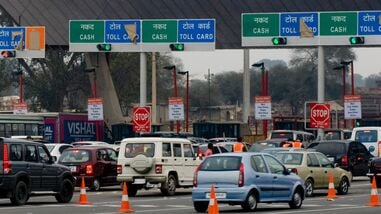
Commuters in the NCR — from Noida, Gurugram, Faridabad and Ghaziabad — may face trouble entering Delhi starting Sunday, November 1, if their vehicles don’t comply with the revised Graded Response Action Plan (GRAP) rules implemented across the national capital to curb air pollution during winters.
According to the Delhi Traffic Police, vehicle entry into Delhi will be restricted under the revised GRAP rules from November 1, 2026.
Under the new measures, vehicles registered outside Delhi that comply with BS-IV or older emission standards (below BS-VI standards) will be prohibited from operating in the city from November 1 to January 31, 2027.
Only vehicles conforming to BS-VI emission standards, CNG and electric vehicles, and those exempted (ambulances, fire tenders, police vehicles) will be allowed to ply in accordance with prescribed rules and exemptions.
1. Vehicles below BS-VI standards
2. Vehicles without a valid PUCC
3. Non-compliant interstate buses
4. Trucks not destined for Delhi (use peripheral expressways)
5. Tractors and jugaad vehicles, as applicable
6. Certain vehicles registered outside Delhi (commercial goods vehicles, two-wheelers are exempted)
From 1 November 2026, vehicle entry into Delhi will be restricted under the revised GRAP rules.
✅ Allowed: BS-VI, CNG, electric and exempted vehicles, subject to applicable rules.
⛔ Restrictions apply to:
* Vehicles below BS-VI standards
* Vehicles without a valid PUCC
* Non-compliant interstate buses
* Trucks not destined for Delhi (use peripheral expressways)
* Tractors and jugaad vehicles, as applicable
* Certain vehicles registered outside Delhi
📅 Check your vehicle’s eligibility before travelling and follow official traffic advisories.
📞 Traffic Helpline: 011-25844444 / 1095
#DTPUpdates
#GRAP2026
More than 10 lakh vehicles in neighbouring NCR areas of Gurugram, Faridabad, Noida, Greater Noida and Ghaziabad could be affected by the Delhi government’s decision to prohibit entry of vehicles below BS-VI (6) emission standards from November 1, 2026 to January 31, 2027, according to the Transport Department estimates cited by news agency PTI.
Earlier, the Supreme Court Bar Association (SCBA) raised objections over restrictions in Delhi on vehicles that do not conform to BS VI emission standards from November 1.
The bar body flagged the difficulties likely to be faced by advocates due to the proposed restrictions, and said that a number of lawyers practising before the Supreme Court commute daily from neighbouring areas including Noida and Ghaziabad in Uttar Pradesh and Gurugram and Faridabad in Haryana.
The SCBA requested the Supreme Court administration to intervene in the issue, according to news agency PTI.
The Noida Traffic Police also issued an advisory informing people of the restrictions in Delhi.
It said, “Except BS-6, CNG and electric vehicles, entry of vehicles, passenger buses, trucks etc. registered in other states outside Delhi has been banned in the state of Delhi.”
The Noida Traffic Police also advised motorists travelling beyond Delhi to consider alternative routes. One suggested route involves taking the Noida Expressway or Yamuna Expressway towards Zero Point, proceeding through Pari Chowk, Kasna and Sirsa and accessing the Eastern Peripheral Expressway to continue the journey.
“In view of the above restriction, vehicles going elsewhere via Delhi will be able to reach their destination using Noida/Greater Noida Expressway/Yamuna Expressway from Zero Point, Parichowk, Kasna town, Sirsa and Eastern Peripheral Expressway,” it added.
Apart from barring the entry of older vehicles registered outside Delhi, a series of sweeping restrictions have been imposed across the national capital from November 1 to combat winter air pollution.
This includes suspending most outdoor construction activities, doubling parking fees and limiting physical attendance in government and private offices to 50 per cent.
The restrictions will remain in force for varying periods between November 1 and February 28.
1. Construction activity: All dust-generating demolition and outdoor civil construction activities will also remain prohibited from November 1 to January 31, except for specified essential public infrastructure projects subject to prescribed conditions. Indoor finishing, plumbing and electrical work may continue provided dust-control standards are followed. In addition, a complete ban on construction and demolition activities, barring specified exemptions, will be imposed between December 10 and January 20.
2. Parking fees double: The government has also directed that parking fees at authorised parking lots across Delhi be doubled from November 1 to February 28. Parking facilities owned and managed by the Delhi Metro Rail Corporation will, however, be exempt from the hike.
3. 50% work from home: Government and private offices will be required to limit physical attendance to 50 per cent from November 1 to January 31, with the remaining employees working from home. Essential and emergency services will be exempted as per prescribed norms.
4. Office timings: In a bid to reduce traffic congestion, Municipal Corporation of Delhi offices will function from 8.30 am to 5 pm, while Delhi government offices will operate from 10 am to 6.30 pm.
Vehicles violating the entry restrictions will be identified through ANPR cameras installed at Delhi’s entry points and other key locations.
E-challans will be generated against non-compliant vehicles, while the traffic police will take action, including impounding vehicles, as per rules. Dedicated teams will also conduct physical inspections.
At construction sites, teams from the DPCC, municipal bodies and other agencies will carry out inspections. Unauthorised construction or demolition activities will attract immediate work-stop notices and environmental compensation penalties, besides sealing and other legal action wherever necessary.
The AI-enabled ICCC will monitor enforcement activities, camera feeds, violations, challans and action taken at construction sites. Special teams have been directed to respond immediately to reports of violations.
1. Merging repeated actions on dust measures, MSW management and transport in Stage-I;
2. Moving actions related to DG Sets and entry of Buses (BS-IV & below) from NCR and Adjoining States from Stage-II to Stage-I;
3. Allowing minor relaxation under Action No. 1, Stage-III – including repairing of potholes;
4. Extension of restrictions on plying of BS-III petrol and BS-IV diesel or below- standard LMVs (4-wheelers) to Sonipat in addition to the existing HVD 5. Districts of Gurugram, Faridabad, Ghaziabad and Gautam Budh Nagar;
6. Removal of exemption for BS-IV and below goods vehicles (LGVs, MGVs in Stage-III and Trucks/ HGVs in Stage-IV) carrying essential commodities in Stage-III and IV;
7. Restrictions on entry of diesel-operated BS-IV and below-standard LGVs and MGVs registered outside Delhi into Delhi has also been clearly mentioned under Stage- III;
8. Citizens Charter under each stage of GRAP has been modified with additional actions (Do’s and Don’ts);
9. Now, the revised GRAP Schedule has 25 actions in Stage-I, 8 actions in Stage-II, 10 actions in Stage-III and 5 actions in Stage-IV, Total: 48 Actions