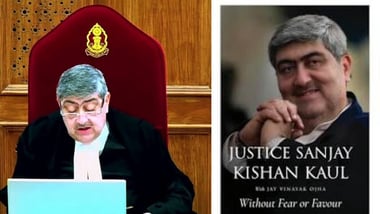
Justice Sanjay Kishan Kaul’s memoir, Without Fear or Favour, chronicles his nearly five-decade-long journey in the Indian judiciary. It traces his career from his early years at the Delhi Bar to his tenures at the Punjab and Haryana High Court, Madras High Court and ultimately the Supreme Court of India.
The book also provides an account of the Supreme Court Collegium’s functioning, offering insights into how judges are selected and appointed. It examines the dynamics between the judiciary and the executive, including the role of judicial consultation in the appointments process.
Kaul, who retired from the on December 25, 2023, after serving for more than six years, said he spent considerable time debating whether to document his experiences before finally beginning to write in April last year.
Speaking to ANI, he said, “It’s always easier not to write than to write…I debated a lot, though the publishers had been behind me even before my retirement to write something because they felt that seeing my judgments, they liked the style…But I really began it only last year in April. I was deferring it.”
Explaining his decision to wait until after retirement, Kaul said he wanted to develop a more dispassionate perspective and avoid writing about people who were still holding public office.
“I also felt that the whole system — political system, press, everybody was raising issues. It’s not possible to keep issues down. Do we not disclose how we work or do we disclose how we work? It has some positives. It has some negatives. That’s what it is about,” he said.
Born on December 26, 1958, in , SK Kaul is a former Supreme Court judge and lawyer who served in the country’s top court from 2017 until his retirement in 2023.
He was the second-most senior judge of the Supreme Court at the time of his retirement and served as a puisne judge, ranking immediately after the Chief Justice of India. During his tenure, he authored judgments in 167 cases.
Before joining the Supreme Court, Kaul served as the Chief Justice of the Madras High Court and the Punjab and Haryana High Court. He also served as a judge and acting Chief Justice of the Delhi High Court. Additionally, he held the position of ex-officio executive chairman of the National Legal Services Authority (NALSA).
Kaul completed his schooling at Modern School in New Delhi and graduated in Economics (Honours) from St Stephen’s College, Delhi University. He subsequently obtained his LLB from the Faculty of Law, University of Delhi, in 1982.
One of the notable subjects in Kaul’s memoir is his relationship with former CJI with whom he served in the Supreme Court. Kaul discussed both his appreciation of Chandrachud’s judicial abilities and their disagreements over the appointment of judges.
“People have been questioning me on writing about former Chief Justice of India, Justice D Y Chandrachud. I have complimented him where I thought he needed a compliment; I said he has a judicial heft. He has the ability to work very hard. Where I questioned him was a specific aspect. Sometimes in your social media systems, that gets blown out of proportion. I disagreed with him on the appointment process,” he told ANI.
Kaul said he believed Chandrachud should have taken a firmer position in pushing for judicial appointments, particularly when recommendations remained pending between January and March.
“I felt he was too soft at times and he should push harder. I used to suggest to him. Like, even the Judicial appointments matter. When nothing happened for a couple of months from January to March, I said this is not going to work…” Kaul mentioned.
“This has been a great difference in perception I have had, if I may say so, with the government of the day and always. Judicial appointments must be made quickly. If we want to get talent and the right kind of talent. If people are not willing to come into it, then you must make the process easy, not make it so cumbersome that it goes on for a long time,” he said.
Despite their differences, Kaul described his relationship with Chandrachud as cordial and said they had interacted comfortably outside their judicial disagreements.
“He was always a little reserved person…Maybe I interacted more easily socially. We’ve shared a good relationship…You can’t close the issues where we differed. I differed with him on this particular aspect,” he stated.
Kaul also recalled his conversations with Prime Minister Narendra Modi, particularly over judicial appointments that were awaiting clearance.
The former judge said he had personally raised the issue with the Prime Minister and urged him to examine pending recommendations.
“He’s a very good listener…Sometimes you are sitting close by and talk, and the appointment of judges has always been a little issue with me. I feel the solution lies in having the right kind of judges. There were some appointments stuck. So I said, “Please look into them.”…This conversation went on for some time.”
Kaul also recalled telling PM Modi that he did not intend to seek any official position or benefit after leaving the Supreme Court.
“I can say this to you because I don’t want anything. I was clear from day one: I will not take anything upon retirement…He responded by saying that I know that…He is a person who has information to the nth degree possible at the ground level,” Justice Kaul said.