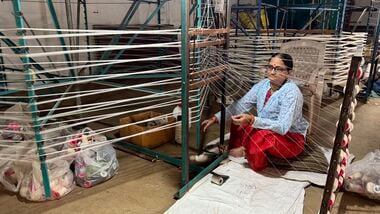
New Delhi: The Ministry of Micro, Small and Medium Enterprises (MSME) has sought ₹6,000 crore to continue its flagship scheme for khadi and village industries for five years through March 2031, as the government weighs further support for a sector that underpins millions of rural livelihoods.
The proposed outlay for the Khadi Gramodyog Vikas Yojana is intended to support artisans, predominantly women, unemployed rural youth, self-help groups and thousands of village industries, three people aware of the development said. Continuing the scheme with adequate funding is also critical to preserving khadi’s legacy as a symbol of India’s freedom struggle, they said.
About 20.4 million people were engaged in khadi and village industries in fiscal year 2026 (FY26), according to the Khadi and Village Industries Commission (KVIC), underscoring the stakes for rural employment and income generation.
The government spent ₹2,374 crore under the scheme in the three years through FY26. It has two components: Khadi Vikas Yojana, which promotes and develops the khadi sector, and Gramodyog Vikas Yojana, which supports village industries through common facilities, technological modernisation, training and other assistance.
“Discussions are ongoing for the Khadi Gramodyog Vikas Yojana, there are plans to continue the targeted support for that ecosystem,” said a government official, one of the people cited above.
The ministry supports khadi manufacturing and village industries through the KVIC, a statutory body established by an Act of Parliament in 1956.
Queries emailed to the MSME and finance ministries and the KVIC on 28 October remained unanswered.
Khadi and village industry product sales reached ₹1.87 trillion in FY26, up 20% from ₹1.55 trillion a year earlier, according to provisional KVIC data released in May. Khadi sales alone rose 10% to ₹7,869 crore in FY26, from ₹7,145 crore a year earlier.
Wages for artisans increased to ₹15 per hank, which is a length of yarn wound into a coil, in FY26, from ₹4 per hank in FY14, according to KVIC data. The length of hank varies by textile.
Khadi, worn and promoted by Mahatma Gandhi, became a symbol of the independence movement and self-reliance during British colonial rule. But sustaining the sector will require more than financial support, industry groups said.
, better practices and stronger links to markets are also needed, particularly because many small businesses in the sector operate outside the formal and have limited financial capacity to pay decent wages.
“International experience offers valuable lessons: Japan’s emphasis on passing skills to the next generation, Thailand’s development of community products for contemporary markets, and France’s recognition of heritage enterprises as businesses of excellence. India can adapt these approaches while protecting the authenticity of khadi, regional craft identities and the interests of producers,” said Vinod Kumar, president of the India SME Forum, an industry lobby group representing around 100,000 MSMEs.
The sector’s longer-term prospects will also depend on its ability to respond to changing consumer needs and production challenges, experts said. Khadi and village industries are rooted in the Gandhian model of development, but their institutions must adapt to contemporary market conditions to better support those who depend on them.
“MSMEs, especially cottage industries, should be looked at as functional partnerships to larger businesses; or as functional relationship builders between the smallest and largest industries, and not just as smaller businesses,” said Pune-based political economist Abhay Tilak, director of the Indian School of Political Economy.
Khadi and village industries now need to respond to demands for healthier products, better-quality textiles and the challenges posed by , he said.
“The support provided by KVIC is essential even in today’s world, but the work done to uplift artisans and their businesses needs to adapt,” Tilak added.