AR Rahman’s latest song for Ramayana, Mangal Rang, has sparked a debate over its musical style, with listeners divided over whether its perceived qawwali influences suit a film based on the Hindu epic.
While some have questioned the composition’s resemblance to Rahman’s earlier work, others have defended the song, arguing that shared musical elements do not automatically make it a qawwali.
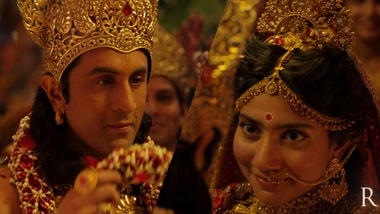
Released on October 25, the wedding song features Arijit Singh and Shreya Ghoshal, with lyrics by Kumar Vishwas. It depicts the union of Rama and Sita, played by Ranbir Kapoor and Sai Pallavi.
One of the main criticisms concerns the song’s chorus, its repeated use of the word “rang” and the guitar arrangement. Some listeners believe these elements give the composition a distinctly -like character.
One user wrote, “Mangal Rang is an obviously qawwali-coded song in – the chorus, the “rang” metaphor (most famously used in Aaj Rang Hai), and the guitar which evokes bulbul tarang (sic).”
Another listener compared the composition with Rahman’s earlier work, particularly Kun Faya Kun, the Sufi song from the 2011 film Rockstar featuring Ranbir Kapoor.
The user wrote, “Mangal Rang from “Ramayana” has clear similarities to A.R. Rahman’s “Kun Faya Kun” the chorus, the singing style, the spiritual lift, the overall architecture. Imagine a Sufi style song attached to Bhagavan Ram and Sita Maa… Is it a deliberate callback? Or an older formula given new packaging? (sic)”
A third reaction questioned whether the makers could have chosen a different musical treatment for the wedding sequence.
The user shared an edited version of the song with alternative music and wrote, “Everyone is criticizing the “Mangal Rang” song from Ramayana, especially the Sufi touch they’ve added to it. I replaced it with another song through a simple edit, and honestly, it makes you wonder… Was it really that difficult to get the musical feel right? With such big music directors working on Ramayana, and Kumar Vishwas involved, nobody thought of something like this? Sometimes, the simplest creative choices make the biggest difference (sic).”
Not everyone agrees with the criticism. Several listeners have argued that the presence of familiar musical elements does not make the song inappropriate for Ramayana. Others have praised the melody and the performances by Arijit Singh and Shreya Ghoshal.
One listener wrote, “mangal rang is the only good song in the album so far (sic).”
Another user directly challenged the comparison with Kun Faya Kun, arguing that a similar-sounding chorus was not enough to classify the composition as qawwali.
The reaction read, “I know that “Rang hai Rang hai Mangal Rang hai” portion is somewhat similar to “Kun Faya Kun” but it doesn’t make it a Qawwali. People who doesn’t even know M of Music are becoming Music critics now just for the sake of demeaning a movie. The song has emotions in it and that’s it (sic).”
A third listener expressed excitement about the release and praised Rahman’s work, “I haven’t yearned for a song release like this since atrangi re album which dropped at midnight and had me listening to the album until 6 am. I’ve already played mangal rang unhealthy number of times over the past 8 hours. God tier @arrahman (sic).”
A simple breakdown of the composition
– The melody draws on Bilawal Thaat, a Hindustani classical scale similar to the major scale used in Western music.
– It also features movements associated with Raag Charukeshi, giving the melody a more expressive, emotional quality.
– The use of natural notes contributes to its bright, flowing sound.
– The repeated chorus and rising vocal arrangement may explain why some listeners hear qawwali-like influences.
– However, these elements alone do not establish that the song is a traditional qawwali or Sufi composition.
– and ‘s vocals carry the song’s celebratory emotion, supporting the wedding sequence without making its genre classification straightforward.
Directed by Nitesh Tiwari, Ramayana Part 1 is a large-scale adaptation of the Hindu epic, with Ranbir Kapoor playing Rama, Sai Pallavi as Sita and as Ravana. The cast also includes Sunny Deol and Ravi Dubey in key roles. The film’s music brings together Rahman and Hollywood composer Hans Zimmer.
The film arrives in theatres on 5 November, 2026.