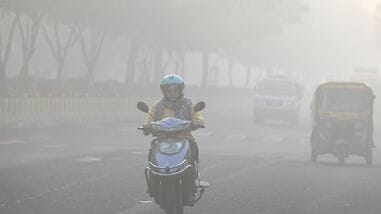
Delhi is set to tighten its ‘No Pollution Under Control (PUC), No Fuel’ enforcement from November 1, 2026, as part of its winter pollution-control measures.
Fuel stations will be required to deny fuel to vehicles without a valid PUC certificate, with number-plate recognition systems being deployed at around 500 fuel stations across the capital, according to a CNBC-TV18 report.
The Delhi government will also bar vehicles registered outside the national capital that do not meet emission standards from entering the city between November 1, 2026, and January 31, 2027, the report says.
Chief Minister Rekha Gupta announced the restrictions on October 20 under the government’s Winter Action Plan, which runs until February 28, 2027. The measures were discussed at a high-level meeting on September 28, chaired by Union Environment Minister and Gupta.
The broader plan includes tighter vehicle checks, higher parking charges, construction restrictions, and changes to office timings to curb emissions and traffic congestion during the winter months, as per the report.
Under the revised enforcement drive, fuel stations across Delhi will not dispense petrol, diesel, or LPG to vehicles that do not have a valid PUC certificate.
The government plans to use Automatic Number Plate Recognition (ANPR) cameras at approximately 500 fuel stations to identify vehicles and check compliance.
Motorists should verify their PUC certificate’s validity and renew it if necessary before visiting a fuel station.
The separate entry restriction will apply to vehicles registered outside Delhi that do not comply with BS6 emission standards. Electric vehicles, CNG vehicles and those used for essential services are exempt.
Vehicles registered in will not be covered by this particular entry ban.
The government has yet to announce detailed arrangements for screening vehicles at the city’s entry points and enforcing the restriction.
Parking charges at authorised municipal parking facilities will double to discourage private vehicle use and encourage commuters to consider alternative modes of transport, as per CNBC TV18.
Parking facilities operated by the Delhi Metro Rail Corporation () are exempt from the increase.
Public and private offices have been directed to stagger their working hours and allow 50% of their staff to work from home to reduce peak-hour traffic and vehicle emissions.
Municipal Corporation of Delhi (MCD) offices will operate from 8:30 am to 5 pm, while Delhi government offices will function from 10 am to 6:30 pm.
The Winter Action Plan also targets dust pollution from construction and demolition activities, as well as the transportation of construction materials.
AI-enabled cameras linked to the government’s control and command centre will monitor major construction sites for compliance with pollution-control requirements.
Dust-intensive construction activities will be prohibited entirely between December 10 and January 20. The government has also announced stricter action against end-of-life vehicles.
Residents are being encouraged to use public transport, including Metro services and , as well as carpooling and last-mile connectivity options.
The measures are intended to reduce dependence on private vehicles during the winter pollution season, when deteriorating air quality frequently becomes a major public health concern in the capital.
The Winter Action Plan is separate from Stage 1 restrictions under the Graded Response Action Plan (GRAP), which has been invoked by the Commission for Air Quality Management (CAQM).
GRAP is a graded framework that prescribes additional restrictions depending on the severity of air pollution across Delhi-NCR. The Winter Action Plan sets out the Delhi government’s own measures for managing pollution over the season.
The government has intensified enforcement at construction sites and identified pollution hotspots for closer monitoring.
The Delhi Pollution Control Committee (DPCC) has issued show-cause notices in cases where construction-site violations were detected.
Separately, the Delhi Cabinet, chaired by Gupta, approved extending mechanised road sweeping to areas that currently lack the service. The initiative will cover approximately 609 km of roads with a right of way of less than 10 metres, spanning 854 roads across 250 municipal wards.
The Cabinet also approved a five-year collaboration with IIT Delhi to monitor and analyse the sources of PM2.5 and PM10 pollution, with the aim of strengthening the evidence base for future -control measures.