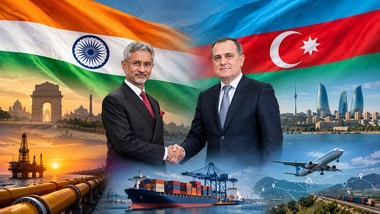
A year after India-Azerbaijan ties soured over the latter’s support for Pakistan during Operation Sindoor, External Affairs Minister S Jaishankar’s visit to Baku, the capital city whose name is likely traced to the Sanskrit word Bagavan meaning “God” or “City of God”, signals a fresh diplomatic push to repair relations.
Jaishankar’s visit comes as New Delhi and Baku seek to revive bilateral engagement after a period of diplomatic friction triggered by the India-Pakistan conflict in May 2025.
Jaishankar, who arrived in on Friday for a one-day visit, held talks with Azerbaijani Foreign Minister Jeyhun Bayramov, describing them as “very productive” and saying the discussions had helped establish a path towards improving bilateral relations.
“Our talks dwelt on further expanding our bilateral relations. We spoke about economic cooperation, including in trade, investment and energy, which are central to our bilateral ties. Given our complementary economies, we believe that there is very good scope for further enhancement of our bilateral trade and investment,” Jaishankar said.
The two sides also agreed to coordinate more closely on the International North-South Transport Corridor (INSTC), a connectivity initiative that could give India greater access to markets across Eurasia.
Situated on the Caspian Sea, Baku has historically been a crossroads of trade and cultural exchanges between Asia and Europe
“We are both invested in the International North-South Transport Corridor. That’s very important for us. We agreed today that we will coordinate more closely in that regard,” added.
The visit, the first by an Indian foreign minister to Azerbaijan in eight years, comes amid efforts to overcome the diplomatic fallout from Azerbaijan’s support for Pakistan following India’s military strikes strained relations, while India’s growing defence partnership with Armenia has been another source of bilateral unease.
Trade and investment could provide a practical foundation for rebuilding relations. According to the Indian Embassy in Baku, bilateral trade reached $401 million in 2025, with Indian exports accounting for $226 million and imports from Azerbaijan standing at $175 million, largely comprising crude oil.
India also has significant energy interests in Azerbaijan. ONGC Videsh Ltd (OVL) has invested more than $1.2 billion in acquiring stakes in the Azeri-Chirag-Gunashli (ACG) oil and gas fields and the associated Baku-Tbilisi-Ceyhan (BTC) pipeline.
In November 2024, OVL acquired an additional 0.615% participating interest in the ACG oil and gas field from Norway’s Equinor for $60 million, alongside a 0.737% stake in the BTC pipeline. The acquisition raised OVL’s interests to 2.925% in ACG and 3.097% in the pipeline.
Jaishankar said the two countries had agreed to deepen cooperation in oil and energy and expand engagement into other sectors.
Connectivity is another potential area for closer cooperation. Delhi and Mumbai have direct air links with Baku, although IndiGo suspended its seven weekly Delhi-Baku flights in January 2026 amid the conflict involving Iran, the US and Israel. Azerbaijan Airlines continues to operate direct services between India and Azerbaijan.
The two countries have also discussed increasing flight frequencies, while Air India announced a codeshare partnership with Azerbaijan Airlines in August 2026. Better air connectivity could support tourism, business travel and wider people-to-people exchanges.
Tourism, however, illustrates both the potential and the vulnerability of these ties. Indian arrivals in Azerbaijan rose from 4,853 in 2014 to 243,589 in 2024, before declining to approximately 166,944 in 2025, according to figures published by the Indian Embassy in Baku.
The decline followed a citizen-led boycott of Azerbaijan by Indian tourists after Baku backed Pakistan during Operation Sindoor.
Jaishankar also thanked for assisting Indian nationals, particularly students evacuated from Iran during the conflict earlier this year.
He acknowledged the care extended to Indian students in Azerbaijan and suggested expanding participation by Azerbaijani professionals in India’s Technical and Economic Cooperation (ITEC) programme.
The renewed engagement builds on Prime Minister Narendra Modi’s brief meeting with Azerbaijani President Ilham Aliyev on the sidelines of the Shanghai Cooperation Organisation summit in Bishkek in September 2026. According to the Indian Embassy in , it was the first in-person interaction between the leaders of the two countries.
The Ministry of External Affairs said terrorism, security issues and common threats were among the subjects discussed during Jaishankar’s visit.
spokesperson Randhir Jaiswal said the two countries recognised the need to cooperate to advance peace, prosperity and security for their citizens and address shared challenges.
Bayramov also welcomed Jaishankar’s visit, saying it provided an opportunity to exchange views on the current state and future prospects of Azerbaijan-India relations.
For New Delhi and Baku, the immediate challenge is to translate this diplomatic opening into tangible cooperation without allowing their respective strategic partnerships to derail progress. Trade, energy, tourism and the INSTC offer avenues for rebuilding ties.
Jaishankar’s visit may have reopened the door to engagement. Whether that translates into a meaningful reset will depend on what follows.