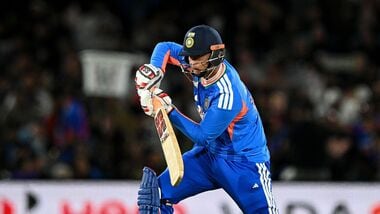
India defeated New Zealand by four wickets in a thrilling second T20I at Christchurch’s Hagley Oval on Saturday to take a 2-0 lead in the five-match series.
Looking to chase down a target of 181, the visitors recovered from a precarious position to seal the win in 19.5 overs, with Tilak Varma (51*) and Nitish Kumar Reddy (26*) playing decisive roles.
After being asked to bat first, New Zealand posted 180/5 on the board following fifties from Glenn Philips (70) and Bevon Jacobs (58).
However, it wasn’t always smooth sailing for the Black Caps as they were restricted to 43/3 in the powerplay. This was after the dismissals of Tim Seifert, Daryl Mitchell and Finn Allen.
We now take a look at five talking points from the second India vs New Zealand T20I in Christchurch.
didn’t get a chance to play in the T20I series against West Indies. Prior to the second T20I, he last played for the country during the 2026 Asian Games in Aichi-Nagoya that took place recently.
The 15-year-old was included in the playing XI after Ishan Kishan sustained an injury during the first T20I. However, retained Sanju Samson and Abhishek Sharma as the opening pair, with Vaibhav batting at number three.
He managed to score just four runs off eight deliveries before falling to Nathan Smith, with Daryl Mitchell completing the catch. He had also received an early reprieve when Bevon Jacobs failed to hold a catching opportunity at point.
India’s run chase didn’t get off to the perfect start the Men in Blue would have wanted. Samson scored 14 off 17 deliveries before falling to Jacob Duffy, while Sooryavanshi’s early dismissal put additional pressure on the middle order.
New Zealand’s bowlers maintained control through the powerplay and middle overs, preventing India from building a substantial partnership. The hosts also benefitted from Mitchell Santner’s introduction, with the left-arm spinner exploiting the conditions to put the visitors under pressure.
found themselves in a spot of bother at 43/3 in the powerplay. Glenn Phillips and Bevon Jacobs added 116 runs for the fourth wicket, taking the hosts from a difficult position to a competitive total of 180/5.
Phillips scored 70 off 43 deliveries, striking four fours and four sixes, while Jacobs made 58 off 46 balls. Their contrasting approaches proved effective: Phillips provided the acceleration, while Jacobs offered stability and ensured the partnership continued.
The partnership also exposed India’s inability to break partnerships once the initial breakthroughs had been secured. Although finished with two wickets, India’s bowling attack conceded 139 runs in the final 14 overs. Bhuvneshwar Kumar was particularly expensive, conceding 50 runs in four overs.
Santner’s performance was arguably the biggest reason why New Zealand came close to defending 180.
The left-arm spinner returned with figures of 4/21, exploiting the slower surface and India’s difficulties in rotating the strike. He dismissed Abhishek Sharma, Shreyas Iyer, Axar Patel and Naman Dhir, disrupting India’s batting momentum at different stages of the chase.
India’s middle-order collapse was particularly significant. From 44/1, the visitors slipped to 70/5 before Naman Dhir and Tilak Varma attempted to rebuild the innings.
India’s recovery from 112/6 was the defining feature of the match. With 69 runs required from the remaining 31 deliveries, New Zealand were favourites to secure victory.
However, and added an unbeaten 69 runs from just 30 balls to take India across the finishing line.
Tilak remained unbeaten on 51 off 26 deliveries, registering his half-century at a strike rate of 196.15. Reddy provided equally important support with 26 not out off 13 balls.
The partnership also exposed New Zealand’s inability to execute their plans at the death. Jacob Duffy conceded 41 runs in 3.5 overs, while Nathan Smith went for 34 in three overs.