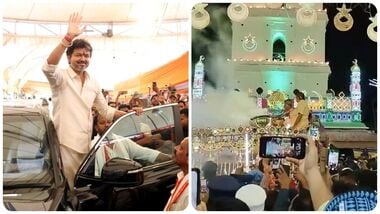
Tamil Nadu Chief Minister C Joseph Vijay on Thursday (22 October 2026) reportedly handed over to a representative of the Nagore Dargah a Government Order (GO) sanctioning the free-of-cost supply of 45 kg of Jajpokal II Class sandalwood for the celebration of the Periya Andavar Kanduri festival on November 10.
According to The Hindu, the order was handed over to Nagore Dargah managing trustee H Haja Najeemudeen Sahib and other trustees.
Minister for Minorities Welfare A.M. Shahjahan, Minister for Labour Welfare and Skill Development J Mohamed Farvas, Minister for Forests RV Ranjith Kumar, and Tamil Nadu Waqf Board Chairman and Ramanathapuram MP K Nawas Kani were present.
Nagore Dargah (also known as Nagore Dargah Shareef) is a revered Sufi shrine located in Nagore, a coastal town in the Nagapattinam District of Tamil Nadu.
It is built over the tomb of Saint Syed Shahul Hameed Raliyallahu Thaa’la Anhu, according to NagoreDargahShariff.com.
The most prominent event held at Nagore Dargah is the Kanduri festival, a fourteen-day commemoration of the saint’s death anniversary.
The shrine is open daily with special timings on Fridays. Major events like the Kanduri festival and sacred rituals such as offerings and holy dips in the Shifa Gunta reflect the rich cultural and spiritual heritage of the site.
The dargah serves as a major pilgrim centre for both Muslims and Hindus. Nagore Dargah is believed to have been built by ardent devotees of Hazrath Shahul Hameed Raliyallahu Thaa’la Anhu, with major contributions from Hindus.
Known for its five minarets and spiritual legacy, it attracts pilgrims from both Islamic and Hindu traditions. There are five minarets in the dargah, with the tallest built by the Hindu Maratha ruler Pratap Singh (1739–1763 CE).
It stands as a symbol of interfaith harmony, with historical contributions from Hindu rulers and devotees, according to the website.
The 14-day Kanduri Festival, also known as the Nagore Dargah Festival, is celebrated from the first to the 14th day of saint Shahul Hameed’s death anniversary during the Islamic month of Jamathul Aagir.
Saint Hazrath Syed Shahul Hameed was the revered 13th-generation descendent of Saint Sufi.
He achieved wider recognition for treating the physical illness of Thanjavur’s 16th-century Hindu king Achuthappa Nayak.
This historic significance allures the peculiar participation of Hindu devotees during the Kandhuri Festival.
The common worship practices during the Kanduri festival include the presentation of offerings, often accompanied by the playing of musical instruments like the nadaswaram, a tradition usually seen in Hindu worship.
Within the dargah complex lies the sacred Shifa Gunta pool, where pilgrims take a holy dip.
The festival’s opening day is commemorated by the hoisting of a sacred flag, which is then carried by chariots to the Nagore Dargah.
From the second to the seventh day, holy saints read the Quran along with various prayers, ANI reported.
The devotees flock to the Dargah to witness the ‘Light’ of Allah which is displayed in the Dargah.
On the eighth day, the Kanduri Festival’s fireworks display is one of its many attractions.
The fireworks have two purposes- first, to enhance the festive atmosphere, and second, to represent how truth drives away falsehood.
On the ninth day of Jamaidul Akhir, the Fakirs visit the site of Hazarath Mohsin meditation site called the “Peer Mandapam”. On this occasion, the devotees start a holy fast for the next three days.
On the 10th day, a parade-like chariot ride carrying sandalwood paste is organised. The Rawla Shariff and the Great Saint’s tomb will then be anointed with the auspicious paste as it is brought inside the premises, according to ANI.
The fast, which began on the ninth day of the festival, is ended bydevotees on the 11th day, the report added.
The Al Quran’s message is recited throughout the 14 days, and its blessings are given to the Great Soul.
The flags and lights are taken down after the conclusion of the Kandhuri Festival, leaving only the spiritual light of the Nagore Dargah.